Enterprise artificial intelligence is increasingly a distributed systems problem. The application that a user sees may live in a public cloud, while the data that grounds its answers remains in a private data center. Model training may run on a GPU cluster in a colocation facility, model artifacts may be stored in a cloud object store, and real-time inference may execute at a factory, hospital, retail location, or other edge site.
This distribution is not an exception. It follows directly from the different technical requirements of AI workloads: access to large datasets, scarce GPU capacity, low-latency inference, data-residency controls, operational resilience, and proximity to the systems that generate or consume data.
The result is an emerging connectivity requirement: organizations need a dependable way to connect AI compute, data, applications, and operational services across separate private IP subnets. Mushroom Networks’ Virtual Leased Line (VLL) provides a routed overlay for this purpose, using bonded Internet connections to link offices, data centers, cloud networks, and edge environments.

Why Modern AI Architectures Span Multiple Locations
A production AI system is more than a model endpoint. Microsoft’s current AI workload architecture pattern separates the environment into data processing, model training and fine-tuning, intelligent applications, operational practices, and platform services. NVIDIA’s AI Enterprise reference architecture similarly covers inference, fine-tuning, and retrieval-augmented generation while treating compute, storage, orchestration, and networking as parts of one production platform.
Those components often belong in different places:
- Data sources may reside in branch offices, factories, clinics, warehouses, vehicles, laboratories, cameras, or industrial systems.
- Data lakes and object stores may be hosted in a public cloud, private cloud, or central data center.
- Training and fine-tuning may run wherever sufficient GPU capacity is available: a cloud region, colocation facility, research lab, or on-premises AI cluster.
- Model and container registries are commonly centralized so that approved versions can be promoted into test and production environments.
- Retrieval and grounding services may need to stay next to regulated documents, proprietary databases, or operational records.
- Inference may run centrally for economies of scale or locally for low latency, availability, privacy, and reduced upstream bandwidth.
- Monitoring, security, identity, and MLOps services may be managed centrally even when execution is distributed.
Kubernetes reinforces this portability. NVIDIA describes Kubernetes as an orchestration layer for containerized AI applications across on-premises, cloud, and hybrid environments, while tools such as Kubeflow Pipelines package repeatable machine-learning workflows as containers. The workload can move, but it still needs network access to repositories, artifacts, data, APIs, and monitoring systems.
Common Hybrid and Distributed AI Workload Patterns
1. Cloud Training with Edge Inference
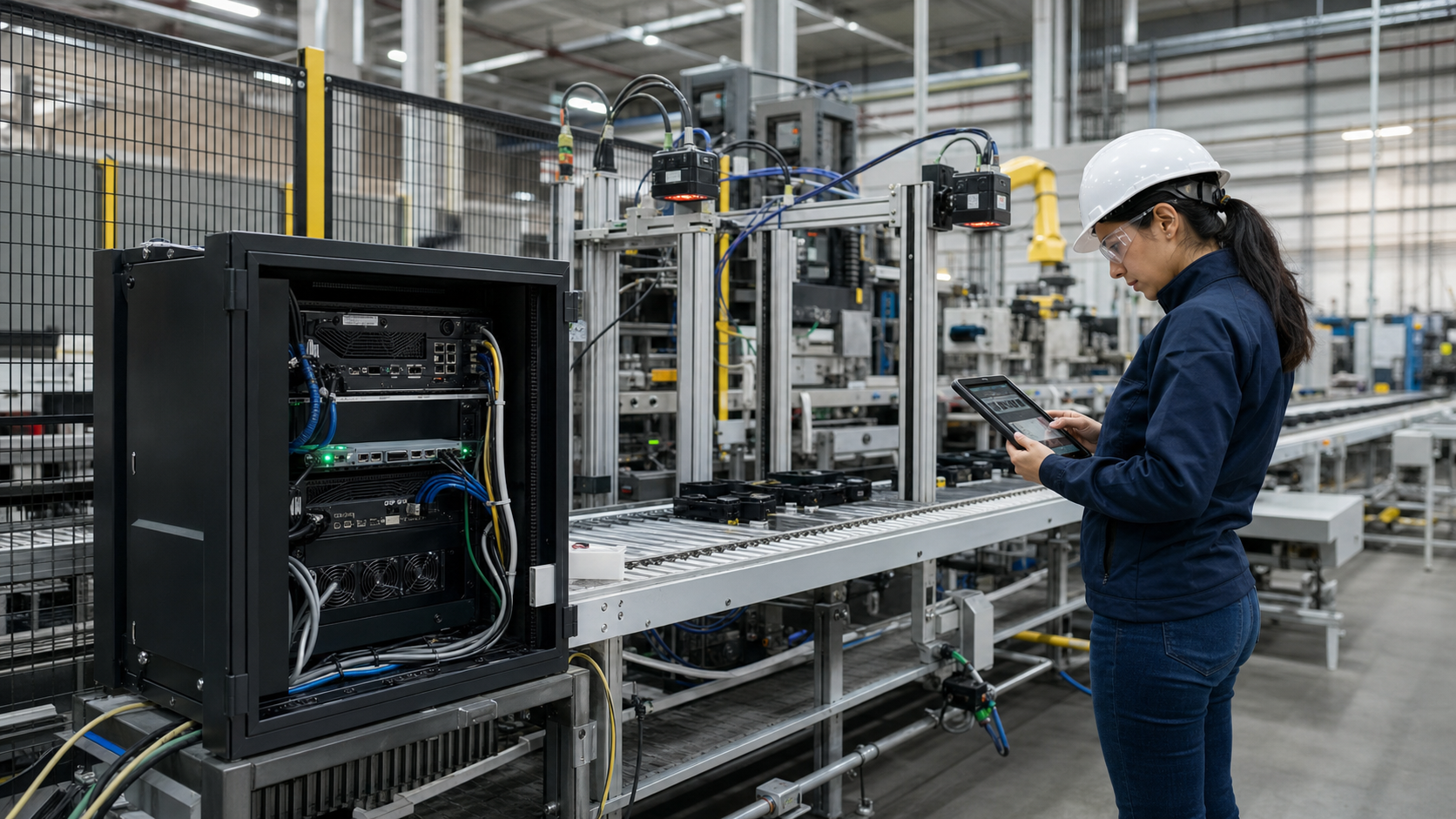
In this pattern, a model is trained or customized in a cloud GPU environment and then deployed to edge systems for local inference. AWS documents this approach with IoT Greengrass machine-learning inference: models can be trained in the cloud, stored as artifacts, and deployed with their runtime and inference code to edge devices. The edge performs predictions against locally generated data while the cloud continues to provide training and lifecycle services.
Typical locations include factories performing visual inspection, retail stores analyzing local video, farms processing sensor and camera data, and remote energy sites detecting equipment anomalies. Microsoft’s edge inference architecture includes image classification and object detection and notes that AI model packages can be large enough to make deployment over narrow or unreliable links a material design concern.
The WAN therefore carries model and container delivery toward the edge, selected telemetry and new samples toward the cloud, and management traffic in both directions. Local inference can continue without putting every prediction on the WAN, but model freshness and fleet operations still depend on reliable connectivity.
2. On-Premises GPU Infrastructure with Cloud Control and Application Services
Some organizations keep GPU infrastructure on-premises because they already own accelerated hardware, must keep sensitive datasets within a controlled facility, or need predictable access to compute. At the same time, they may use cloud services for orchestration, application hosting, CI/CD, observability, collaboration, and elastic capacity.
This control-plane/data-plane split is already common in hybrid Kubernetes. For example, Azure Arc attaches Kubernetes clusters running in customer data centers, edge locations, and other clouds through an outbound connection to a centralized management plane. AWS also documents an Outposts architecture in which the Kubernetes control plane remains in an AWS Region while worker nodes and application data traffic operate on-premises.
For AI, the practical traffic includes source code, container images, training jobs, model checkpoints, datasets, metrics, and inference requests. The local GPU fabric handles tightly coupled computation, while the WAN connects the cluster to everything outside that facility.
3. Hybrid Retrieval-Augmented Generation
A retrieval-augmented generation (RAG) application often crosses several security and network zones. The user-facing application and language model may run in the cloud, while enterprise documents, search indexes, operational databases, and access-control systems remain on-premises. In another design, both retrieval and inference run locally, while model management and application development remain centralized.
These flows are usually more interactive than bulk training transfers. A request may traverse an application gateway, embedding or retrieval service, vector or search database, reranker, model endpoint, and logging pipeline before returning an answer. Poor latency or intermittent connectivity at any boundary can increase response time or cause the transaction to fail.
The network should expose only the required private services rather than flattening the security architecture. Routed subnet connectivity allows an AI application subnet to reach approved retrieval or data-service subnets while firewalls and identity systems continue to enforce policy.
4. Distributed Agentic AI and Development Workers
Agentic AI systems increasingly separate cloud-based reasoning or orchestration from execution environments that customers operate themselves. Devin Outposts is one example: its planning loop remains in the vendor cloud, while commands, repository operations, builds, and file changes execute on customer-controlled workers.
The public control channel may need only outbound HTTPS, but the worker still needs access to private Git servers, artifact repositories, package registries, test labs, databases, development APIs, and deployment environments. If those resources are distributed across a data center, cloud VPC, and remote engineering site, the agent becomes another consumer of the enterprise WAN.
5. Multi-Site Computer Vision and Operational AI
Computer vision illustrates why edge and cloud components frequently coexist. Cameras generate high-volume streams at the site. Local GPUs can filter frames, detect objects, or trigger an immediate operational response. A central platform may receive events, selected clips, metrics, and difficult samples for review and future retraining.
Google’s edge hybrid architecture pattern recommends keeping time- and business-critical processing at the edge while using the cloud for management and asynchronous synchronization. It specifically calls out factories, power plants, retail stores, vehicles, and other environments where continuous high-quality Internet connectivity cannot be assumed.
The AI Traffic Types a WAN Must Support
It is useful to classify AI traffic before designing the network because each class behaves differently.
- Datasets and checkpoints: Very large, throughput-sensitive transfers that can occupy a link for hours.
- Container images and model artifacts: Bursty downloads that affect how quickly workers, GPU nodes, and edge sites can start or update workloads.
- Interactive inference and RAG calls: Smaller transactions whose user experience is sensitive to latency, loss, and interruption.
- Streaming sensor and video data: Continuous upstream traffic that may require prioritization and predictable capacity.
- MLOps and control traffic: API calls, job specifications, registry operations, deployment instructions, and secrets retrieval.
- Telemetry: Logs, metrics, traces, model-quality signals, and audit records traveling toward central monitoring systems.
A single best-effort Internet connection may become both a performance bottleneck and a failure domain. Adding another ISP only solves part of the problem if traffic is merely divided at a session level and ongoing flows cannot adapt when a link degrades.
How VLL Connects the Distributed AI Data Plane
VLL creates a bidirectional IP tunnel between Mushroom Networks endpoints and forwards traffic that matches the configured remote subnet. Because it is routed connectivity, an edge AI subnet can reach a cloud service subnet without placing both locations in one Layer 2 broadcast domain.
The tunnel can use several WAN connections at each participating location. Mushroom’s broadband bonding and VLL architecture supports different access types and providers, including fiber, cable, DSL, dedicated Internet, fixed wireless, cellular, satellite, and MPLS. This provides two benefits that are particularly relevant to AI:
- More usable capacity: Bulk model, image, checkpoint, dataset, and artifact transfers can use the aggregated transport available to the site.
- Path resilience: The overlay can continue operating while at least one usable path remains, reducing dependence on an individual carrier.
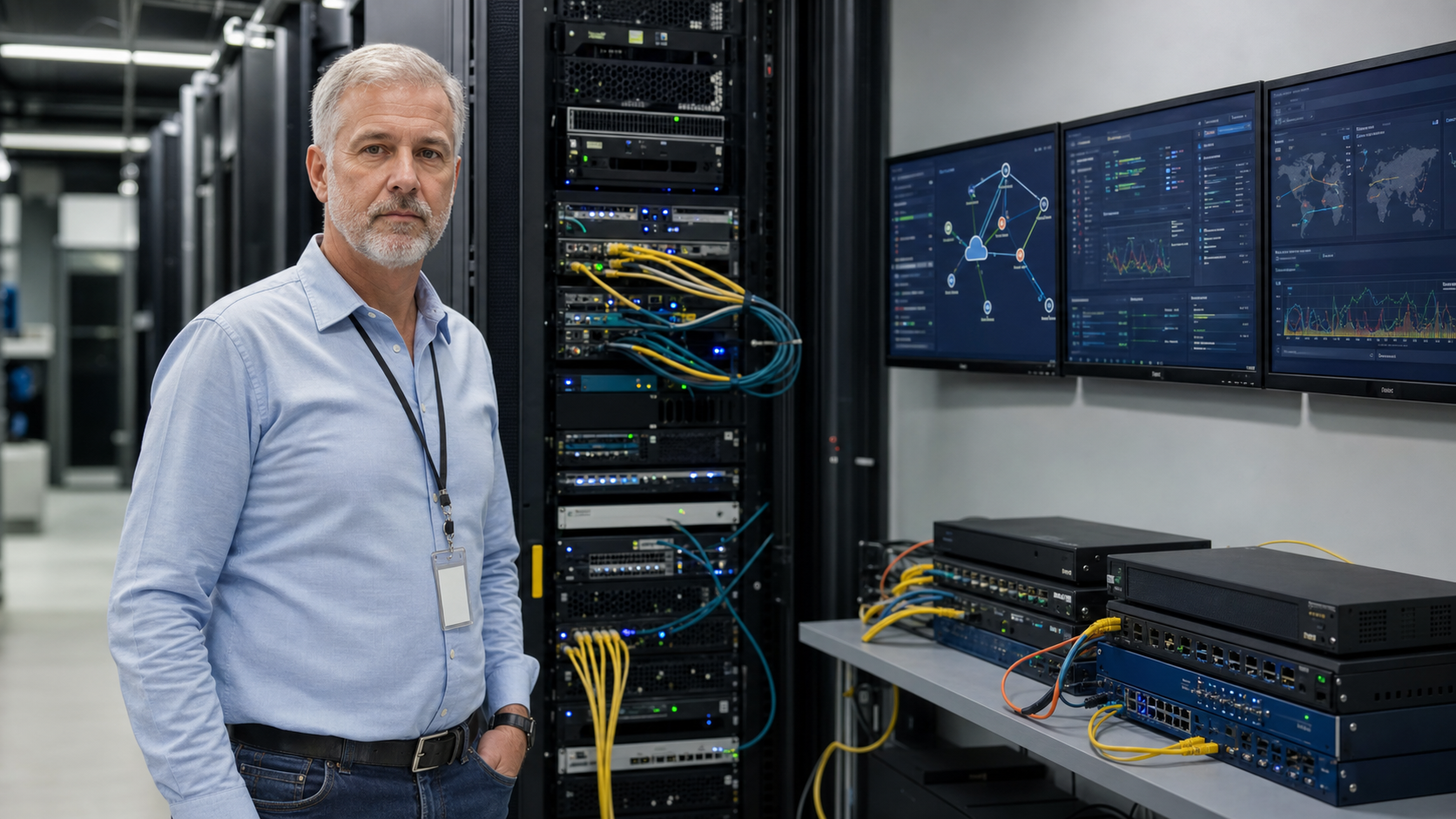
A physical appliance can terminate VLL at a branch, laboratory, factory, clinic, or data center. Truffle V can provide a virtual endpoint in a data center or cloud environment. That makes it possible to construct a private routed fabric across physical sites and virtual networks without requiring the underlying Internet providers to coordinate with one another.
Reference VLL Topologies for AI Infrastructure
Hub and Spoke for Central AI Services
A data center or cloud VPC acts as the hub and hosts the model registry, object storage gateway, central observability, and shared inference services. Factories, branches, clinics, or research sites connect as spokes. Each site retains a unique local subnet, and the hub receives a route for every remote AI subnet.
This is a practical pattern when most communication is between remote sites and central services. It also limits the number of tunnels that each edge location must maintain.
Cloud-to-Data-Center VLL
One endpoint is placed at the enterprise data center and another in the cloud network. Cloud applications and elastic GPU workers can then reach approved on-premises storage, retrieval, licensing, and operational systems through private addresses. Mushroom describes a similar cloud termination model in its guide to using VLL with AWS connectivity.
Regional AI Hubs
A larger organization may place GPU and storage resources in regional hubs, with nearby edge sites connecting to the closest region. The regional hubs can then be interconnected. This reduces long-distance traffic for common operations while preserving access to global model registries, governance, and disaster-recovery resources.
Selected Mesh Connections
Direct VLL tunnels can be added where two sites exchange enough AI traffic to justify bypassing a central hub—for example, a data-generation facility transferring training samples directly to a GPU center. Mesh connections should be selective so routing and security policies remain manageable.
What VLL Should Not Replace
VLL is a wide-area connectivity technology. It should not be confused with the high-speed east-west fabric inside a multi-GPU training cluster.
Tightly coupled distributed training can depend on specialized low-latency networking, RDMA, high-speed Ethernet or InfiniBand, GPU-direct storage paths, and topology-aware scheduling. NVIDIA’s architecture documentation describes dedicated networking technologies for feeding GPUs and coordinating scale-out computation. That traffic belongs on a local cluster fabric engineered for microsecond-scale behavior—not across a public WAN.
VLL instead connects the AI cluster’s north-south dependencies: remote storage, data sources, users, registries, application services, cloud platforms, backup environments, and other locations.
Technical Design Considerations
Use Unique, Non-Overlapping Subnets
Every connected environment should have an unambiguous address plan. VLL requires the LAN networks at its endpoints to be distinct and non-overlapping. For example:
- Central AI services:
10.10.0.0/16 - GPU data center:
10.20.0.0/16 - Factory edge AI:
10.31.0.0/16 - Retail edge AI:
10.32.0.0/16 - Cloud AI VPC:
10.40.0.0/16
If additional application or data networks sit behind a router, Mushroom manual VLL routes can associate those destination prefixes with the correct Remote LAN connection.
Route Private AI Prefixes Deliberately
Not every Internet flow needs to traverse the private overlay. A good design sends traffic for approved enterprise and cloud subnets through VLL while allowing public SaaS, model APIs, software updates, and other Internet destinations to use the appropriate direct egress path. This avoids unnecessary backhaul and keeps the failure domains clear.
Preserve Security Boundaries
Reachability is not authorization. Firewalls, security groups, access-control lists, workload identity, mutual TLS, secrets management, and application permissions should continue to control which AI workloads can reach which resources. Separate worker, training, inference, retrieval, management, and data networks when their risk profiles differ.
Prioritize Interactive and Operational Traffic
A model checkpoint transfer should not starve a production inference API or a factory alert. Classify traffic by source, destination, protocol, and application requirement, then apply QoS so interactive inference, control traffic, and operational events retain sufficient capacity during bulk transfers.
Plan for Data Gravity
Bonding increases available WAN capacity, but it does not eliminate the cost of moving unnecessarily large datasets. Keep latency-sensitive processing near the data, filter or summarize edge streams, cache frequently used models and containers, and replicate only the information required by another location. The network should support the architecture, not compensate for avoidable data movement.
Test Failure, Not Just Throughput
Validation should include long model downloads, registry pulls, concurrent inference calls, telemetry uploads, and an intentional failure of each WAN connection. Measure completion time, retransmissions, application errors, latency, and whether active sessions survive the transition. AI availability depends on the behavior of the complete workflow, not only a speed-test result.
Building a Resilient Network Fabric for Hybrid AI
AI infrastructure is becoming more distributed because compute, data, governance, and real-time operations have different placement requirements. Cloud platforms provide elastic services and centralized management. Private data centers offer control and existing GPU investment. Edge systems provide local response and continued operation when the WAN is constrained. Production architectures increasingly use all three.
Mushroom Networks VLL provides the routed connectivity layer that can join these environments into a resilient private network. Each location keeps its own subnet and security policies, while approved AI services become reachable across bonded Internet paths. Model artifacts can reach remote inference sites, cloud applications can access permitted private data services, and distributed workers can communicate with central registries and operational systems.
The objective is not to place every AI packet inside one tunnel. It is to build a deliberate data plane in which each workload uses the right path: local cluster fabrics for tightly coupled GPU traffic, local processing for time-critical edge inference, and resilient VLL connectivity for communication between geographically separated AI environments.
At Mushroom Networks Inc., we specialize in creating robust networking solutions that guarantee uptime and optimize performance. Our multi-WAN load balancing devices and SD-WAN capabilities ensure your business remains connected and efficient, seamlessly combining various internet links to create a resilient and high-speed network. Explore our advanced solutions at https://www.mushroomnetworks.com.