In today’s hyper-connected business environment, a reactive security posture is no longer a viable strategy. For technical IT leaders, the core challenge has shifted from simply defending the perimeter to architecting a resilient, intelligent, and agile security framework that spans from the data center to the distributed edge. This requires a move beyond legacy models and an embrace of a comprehensive strategy that actively anticipates threats, contains breaches, and minimizes the overall attack surface.
This guide provides a detailed roundup of the most critical network security best practices for modern enterprises. We will move beyond high-level theory to deliver actionable insights, specific implementation details, and practical examples you can apply directly. From architecting a Zero Trust framework and implementing microsegmentation to deploying advanced Endpoint Detection and Response (EDR), you will gain the technical knowledge needed to fortify your infrastructure.
We will cover ten key areas, including multi-factor authentication, robust patch management, SIEM integration, and effective incident response planning. Each section is designed to help you build a more secure, compliant, and defensible network capable of withstanding sophisticated cyber attacks. Let’s dive into the essential practices that will define your organization’s security success.
1. Implement a Zero Trust Security Architecture (ZTA)
The foundational principle of modern network security best practices is shifting away from a perimeter-based defense model to a Zero Trust Architecture (ZTA). This framework operates on the maxim, “never trust, always verify,” treating every access request as a potential threat, regardless of its origin. For IT leaders, this means abandoning the outdated idea of a secure internal network and instead focusing on verifying identity and context for every single transaction.
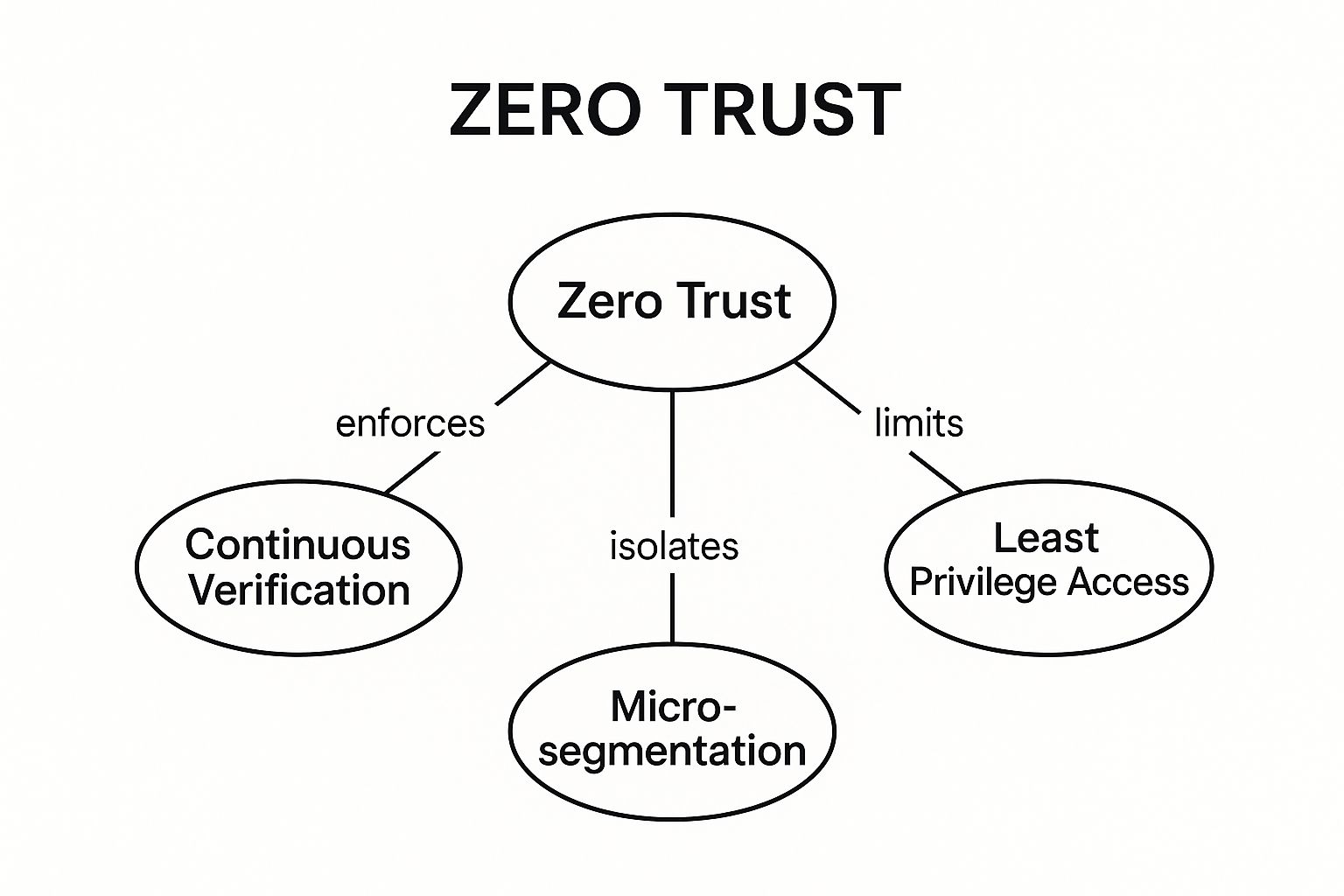
In a ZTA model, security is identity-centric, not location-centric. Every user, device, and application must be authenticated and authorized before gaining access to resources. This granular control is essential for protecting distributed assets across multi-cloud environments and remote workforces. Prominent examples include Google’s BeyondCorp, which secures corporate applications without relying on a traditional VPN.
Actionable Implementation Strategy
Successfully deploying ZTA requires a phased, strategic approach rather than a complete overhaul.
- Start with Identity: Make Identity and Access Management (IAM) your cornerstone. Implement strong multi-factor authentication (MFA) and enforce the principle of least privilege, granting users only the minimum access necessary to perform their roles.
- Map Your Environment: Before implementation, conduct a thorough discovery process to map all data flows, user access patterns, and critical assets. Understanding these dependencies is crucial for creating effective micro-segmentation policies.
- Launch Pilot Programs: Begin with a small, controlled group or a non-critical application. This allows your team to refine policies and troubleshoot issues before a full-scale rollout, minimizing disruption. This approach aligns with the continuous improvement cycle inherent in robust network security solutions.
2. Enforce Multi-Factor Authentication (MFA) Across All Access Points
Beyond foundational architecture, the next critical layer in robust network security best practices is the stringent enforcement of Multi-Factor Authentication (MFA). MFA serves as a powerful defense against credential theft by requiring users to provide two or more verification factors before granting access. This moves security beyond a single point of failure (a compromised password) by layering proof of identity through something the user knows (password), has (token or phone), and is (biometric data).
For IT leaders, MFA is a non-negotiable control for protecting sensitive data, privileged accounts, and remote access gateways. It dramatically reduces the attack surface, mitigating risks from phishing, brute-force attacks, and credential stuffing. Prominent implementations like Microsoft Azure Active Directory MFA and Google Workspace 2-Step Verification have become standard for securing enterprise cloud resources, while solutions like Duo Security are widely adopted in sectors like higher education to protect vast, diverse user bases.
Actionable Implementation Strategy
Deploying MFA effectively requires careful planning to maximize security without creating undue friction for users.
- Prioritize Secure Factors: Steer away from less secure methods like SMS-based codes, which are vulnerable to SIM-swapping attacks. Instead, prioritize more secure factors such as authenticator apps (e.g., Google Authenticator, Microsoft Authenticator), push notifications, or hardware tokens like FIDO2/WebAuthn security keys.
- Implement Risk-Based Authentication: Use a conditional access policy approach. This advanced strategy, often called adaptive authentication, adjusts MFA requirements based on context like user location, device health, or sign-in risk level. A user logging in from an unrecognized network might be prompted for MFA, while a user on a trusted corporate device might not.
- Establish Clear User Support: Proactively develop and communicate clear user training materials and robust account recovery procedures. A well-defined support plan is essential to manage lockouts and resistance, ensuring a smooth transition and high adoption rates across the organization.
3. Network Segmentation and Microsegmentation
Beyond authenticating users, controlling internal traffic flow is a critical layer of modern network security best practices. Network segmentation involves dividing a larger network into smaller, isolated sub-networks or segments. This practice contains lateral movement by threat actors, ensuring that a breach in one segment does not compromise the entire infrastructure. For IT leaders, this means moving past a flat network topology to a compartmentalized one that drastically reduces the attack surface.

Microsegmentation takes this concept further by creating granular security zones around individual workloads or applications, irrespective of their location in the data center or cloud. This software-defined approach allows for highly specific policies, such as only allowing an application server to communicate with its designated database. Prominent examples include VMware NSX, which provides deep visibility and control in virtualized environments, and Illumio, which offers platform-agnostic workload security.
Actionable Implementation Strategy
Successfully deploying ZTA requires a phased, strategic approach rather than a complete overhaul.
- Start with Identity: Make Identity and Access Management (IAM) your cornerstone. Implement strong multi-factor authentication (MFA) and enforce the principle of least privilege, granting users only the minimum access necessary to perform their roles.
- Map Your Environment: Before implementation, conduct a thorough discovery process to map all data flows, user access patterns, and critical assets. Understanding these dependencies is crucial for creating effective micro-segmentation policies.
- Launch Pilot Programs: Begin with a small, controlled group or a non-critical application. This allows your team to refine policies and troubleshoot issues before a full-scale rollout, minimizing disruption. This approach aligns with the continuous improvement cycle inherent in robust network security solutions.
2. Enforce Multi-Factor Authentication (MFA) Across All Access Points
Beyond foundational architecture, the next critical layer in robust network security best practices is the stringent enforcement of Multi-Factor Authentication (MFA). MFA serves as a powerful defense against credential theft by requiring users to provide two or more verification factors before granting access. This moves security beyond a single point of failure (a compromised password) by layering proof of identity through something the user knows (password), has (token or phone), and is (biometric data).
For IT leaders, MFA is a non-negotiable control for protecting sensitive data, privileged accounts, and remote access gateways. It dramatically reduces the attack surface, mitigating risks from phishing, brute-force attacks, and credential stuffing. Prominent implementations like Microsoft Azure Active Directory MFA and Google Workspace 2-Step Verification have become standard for securing enterprise cloud resources, while solutions like Duo Security are widely adopted in sectors like higher education to protect vast, diverse user bases.
Actionable Implementation Strategy
Deploying MFA effectively requires careful planning to maximize security without creating undue friction for users.
- Prioritize Secure Factors: Steer away from less secure methods like SMS-based codes, which are vulnerable to SIM-swapping attacks. Instead, prioritize more secure factors such as authenticator apps (e.g., Google Authenticator, Microsoft Authenticator), push notifications, or hardware tokens like FIDO2/WebAuthn security keys.
- Implement Risk-Based Authentication: Use a conditional access policy approach. This advanced strategy, often called adaptive authentication, adjusts MFA requirements based on context like user location, device health, or sign-in risk level. A user logging in from an unrecognized network might be prompted for MFA, while a user on a trusted corporate device might not.
- Establish Clear User Support: Proactively develop and communicate clear user training materials and robust account recovery procedures. A well-defined support plan is essential to manage lockouts and resistance, ensuring a smooth transition and high adoption rates across the organization.
3. Network Segmentation and Microsegmentation
Beyond authenticating users, controlling internal traffic flow is a critical layer of modern network security best practices. Network segmentation involves dividing a larger network into smaller, isolated sub-networks or segments. This practice contains lateral movement by threat actors, ensuring that a breach in one segment does not compromise the entire infrastructure. For IT leaders, this means moving past a flat network topology to a compartmentalized one that drastically reduces the attack surface.
Microsegmentation takes this concept further by creating granular security zones around individual workloads or applications, irrespective of their location in the data center or cloud. This software-defined approach allows for highly specific policies, such as only allowing an application server to communicate with its designated database. Prominent examples include VMware NSX, which provides deep visibility and control in virtualized environments, and Illumio, which offers platform-agnostic workload security.
Actionable Implementation Strategy
Deploying effective segmentation requires careful planning and a phased rollout to avoid disrupting critical business operations.
- Start with Critical Assets: Identify and map your most sensitive data and high-value applications first. Build security perimeters around these “crown jewels” and then expand your segmentation strategy outward to less critical systems.
- Leverage Automation: Manually managing segmentation policies at scale is impractical and prone to error. Utilize automated tools for policy discovery, generation, and enforcement to maintain consistency and adapt to dynamic environments.
- Implement Comprehensive Monitoring: Segmentation is not a set-it-and-forget-it solution. Implement robust logging and traffic flow monitoring to validate that policies are working as intended, detect unauthorized access attempts, and identify policy gaps.
- Regularly Review and Refine: Your network environment is constantly evolving. Schedule periodic reviews of segmentation policies to ensure they align with current application dependencies, business requirements, and the latest threat intelligence.
4. Regular Security Updates and Patch Management
A cornerstone of proactive network security best practices is establishing a systematic process for patch management. This involves identifying, testing, and deploying security updates across all network devices, operating systems, and applications. Unpatched vulnerabilities are a primary entry point for attackers, making timely updates a non-negotiable defense against known threats and a critical component of maintaining a strong security posture.
For IT leaders, this means moving beyond ad-hoc patching to a structured, policy-driven program. The goal is to close security gaps before they can be exploited, effectively reducing the network’s attack surface. Automated tools like Microsoft WSUS for Windows environments or Red Hat Satellite for Linux systems can streamline this process, while comprehensive solutions like Qualys VMDR offer enterprise-wide visibility and control over patch deployment.
Actionable Implementation Strategy
An effective patch management strategy requires discipline, automation, and rigorous testing to prevent operational disruptions.
- Establish a Rhythm: Create and enforce a regular patching schedule, often aligned with vendor release cycles like Microsoft’s “Patch Tuesday.” This predictability helps manage expectations and allocate resources efficiently. Prioritize critical and high-risk vulnerabilities for immediate action outside of the standard schedule.
- Know Your Assets: You can’t patch what you don’t know you have. Maintain a comprehensive and continuously updated inventory of all hardware and software assets on your network. This inventory is the foundation for ensuring complete patch coverage.
- Test Before You Deploy: Always validate patches in a non-production, sandboxed environment that mirrors your live systems. This crucial step identifies potential conflicts or performance issues, preventing a security fix from causing an operational outage. This proactive approach is fundamental to a robust cybersecurity strategy within modern networks.
5. Comprehensive Backup and Disaster Recovery Planning
A reactive security posture is insufficient; a proactive approach to resilience is a core tenet of modern network security best practices. Comprehensive backup and disaster recovery (DR) planning ensures your organization can withstand and rapidly recover from security incidents like ransomware, catastrophic system failures, or natural disasters. For IT leaders, this means moving beyond simple data backups to creating a robust, testable framework that guarantees business continuity.
This strategy treats data protection as an active defense mechanism. A well-designed DR plan minimizes downtime and data loss, which are critical for maintaining operational integrity and customer trust. Leading solutions in this space include Veeam Backup & Replication for on-premises and cloud environments, as well as cloud-native services like AWS Disaster Recovery and Microsoft Azure Site Recovery, which enable orchestrated failover to secondary sites.
Actionable Implementation Strategy
Effective DR planning is a continuous cycle of preparation, testing, and refinement.
- Implement the 3-2-1-1-0 Rule: A modern take on the classic 3-2-1 rule is essential. Maintain three copies of your data on two different media types, with one copy stored off-site. Crucially, add a one immutable or air-gapped copy that is offline and cannot be altered, and aim for zero errors after recovery verification.
- Encrypt and Isolate Backups: All backup data must be encrypted, both in transit and at rest. Air-gapped or immutable storage is your last line of defense against ransomware that targets backup repositories, ensuring a clean recovery source is always available.
- Test Relentlessly: A DR plan that hasn’t been tested is merely a document. Regularly conduct full restoration drills to validate data integrity, recovery time objectives (RTOs), and recovery point objectives (RPOs). This process also helps ensure that you can achieve the high levels of internet reliability necessary for business continuity.
6. Deploy Endpoint Detection and Response (EDR)
While network-level defenses are crucial, securing the endpoints where users and data interact is equally vital. Endpoint Detection and Response (EDR) extends beyond traditional antivirus by providing continuous monitoring and advanced threat detection capabilities directly on devices like laptops, servers, and mobile phones. This technology is a core component of modern network security best practices because it offers deep visibility into endpoint activities, allowing security teams to uncover and neutralize threats that bypass perimeter defenses.
EDR solutions continuously collect and analyze endpoint data, using behavioral analysis and machine learning to identify suspicious activities in real time. This proactive approach enables rapid incident response, containment, and investigation. Leading platforms like CrowdStrike Falcon and Microsoft Defender for Endpoint provide the tools necessary to automatically isolate compromised devices, investigate threat timelines, and remediate attacks before they can spread across the network.
Actionable Implementation Strategy
Integrating EDR effectively requires more than just deploying an agent; it demands a strategic alignment with your existing security operations.
- Integrate with Your Security Stack: Connect your EDR platform with your SIEM and SOAR solutions. This integration creates a unified security ecosystem where endpoint alerts can be correlated with network events, automating response workflows and enriching incident context for faster resolution.
- Tune for Your Environment: Out-of-the-box EDR rules can generate a high volume of false positives. Dedicate time to fine-tuning detection rules based on your organization’s specific applications and user behaviors to reduce alert fatigue and focus analysts on genuine threats.
- Prioritize Team Training: An EDR tool is only as effective as the analysts using it. Invest in training your security team on the platform’s investigation and threat-hunting workflows. This ensures they can leverage its full capabilities to proactively identify and mitigate advanced threats.
7. Adopt a Security Information and Event Management (SIEM) System
To achieve comprehensive visibility across a complex network, adopting a Security Information and Event Management (SIEM) system is one of the most critical network security best practices. A SIEM platform aggregates, correlates, and analyzes log data from firewalls, servers, applications, and endpoints. This centralized approach transforms raw data into actionable intelligence, enabling security teams to detect threats, investigate incidents, and manage compliance from a single console.
Modern SIEM solutions move beyond simple log collection. They use advanced analytics and machine learning to identify anomalous behavior that could indicate a sophisticated attack, such as lateral movement or data exfiltration. For IT leaders, a well-implemented SIEM like Splunk Enterprise Security or IBM QRadar provides the unified security oversight necessary to protect distributed digital assets and respond to threats in real time.
Actionable Implementation Strategy
Deploying a SIEM effectively requires careful planning and continuous refinement to avoid generating overwhelming alert fatigue.
- Define High-Value Use Cases First: Instead of ingesting all possible data at once, begin by focusing on critical security objectives. Start with use cases like detecting failed login attempts across multiple systems, monitoring for unauthorized access to sensitive data, or tracking changes to critical system configurations.
- Establish Clear Data Retention Policies: Work with legal and compliance teams to define how long log data must be stored. Tier your storage based on need, keeping recent, “hot” data readily accessible for immediate analysis while archiving older, “cold” data in more cost-effective storage.
- Continuously Tune Correlation Rules: A SIEM is not a “set and forget” tool. Regularly review and tune correlation rules to reduce false positives and adapt to new threat vectors. This iterative process ensures that alerts remain relevant and actionable for your Security Operations Center (SOC) team.
8. Employee Security Awareness Training
While technology provides a critical defense layer, the human element remains a primary attack vector. Employee security awareness training is a systematic educational program designed to transform your workforce from a potential liability into a proactive line of defense. For IT leaders, this means moving beyond annual compliance training and embedding a continuous culture of security-mindedness that addresses evolving threats like sophisticated phishing and social engineering.
This approach acknowledges that even the most robust network security best practices can be undermined by a single uninformed click. By empowering employees to recognize and report threats, you significantly reduce the risk of initial compromise. Leading platforms like KnowBe4 and Proofpoint have institutionalized this practice by combining engaging training modules with realistic threat simulations, effectively hardening the “human firewall” against common and advanced attacks.
Actionable Implementation Strategy
An effective training program is ongoing, relevant, and measurable, not a one-off event.
- Implement Phishing Simulations: Regularly test employees with simulated phishing emails. Use these campaigns to gather baseline data, identify vulnerable departments or individuals, and provide immediate, contextual training to those who click. This data-driven approach proves ROI and targets remedial efforts where they are most needed.
- Make Training Engaging and Relevant: Ditch generic, text-heavy modules. Use short, interactive videos, real-world examples drawn from recent headlines, and gamification to keep staff engaged. Tailor content to specific roles; for instance, finance teams need specialized training on business email compromise (BEC) scams.
- Foster a Positive Security Culture: Reward and recognize employees who report suspicious activity. Frame security not as a punitive measure but as a shared responsibility. This encourages proactive reporting rather than a fear of admitting mistakes, which is crucial for rapid incident response.
9. Vulnerability Assessment and Penetration Testing
A proactive stance is a non-negotiable component of modern network security best practices. Vulnerability assessment and penetration testing (VAPT) embodies this principle by systematically identifying, quantifying, and exploiting security weaknesses. This dual approach moves beyond passive defense, allowing IT leaders to actively pressure-test their security controls from an attacker’s perspective and validate their effectiveness before a real adversary does.
Vulnerability assessment uses automated tools like Tenable Nessus or Qualys VMDR to scan networks and systems for known weaknesses, providing a broad overview of potential security gaps. Penetration testing is a more targeted, manual process where security experts simulate a real-world attack to exploit discovered vulnerabilities. This combination provides a comprehensive picture, highlighting not just what is vulnerable, but how those vulnerabilities could be chained together to compromise critical assets.
Actionable Implementation Strategy
Integrating VAPT into your security program requires a structured, cyclical approach to yield meaningful results and drive continuous improvement.
- Define a Clear Scope and Schedule: Before any testing, clearly define the scope, rules of engagement, and schedule. Focus initial efforts on high-value assets and internet-facing systems. Schedule these assessments regularly, such as quarterly for critical systems and annually for the broader network, to keep pace with emerging threats.
- Combine Automated and Manual Techniques: Rely on automated scanning for broad, continuous coverage to catch low-hanging fruit and known CVEs. Complement this with manual penetration tests conducted by skilled professionals or a trusted security firm to uncover complex logic flaws and business-specific risks that automated tools often miss.
- Prioritize and Remediate Findings: The goal of testing is remediation. Use a risk-based approach to prioritize findings based on severity, exploitability, and potential business impact. Integrate the remediation workflow into your existing IT and development processes to ensure accountability and track progress effectively.
10. Incident Response Planning and Management
Even with the most robust defenses, security incidents are inevitable. A formal Incident Response (IR) plan is a critical component of network security best practices, providing a structured approach to prepare for, detect, and neutralize threats. For IT leaders, this isn’t just about damage control; it’s about building organizational resilience and minimizing operational, financial, and reputational harm when a breach occurs.
An effective IR plan moves your team from a reactive, chaotic state to a coordinated, efficient response. It clearly defines roles, responsibilities, and communication protocols, ensuring everyone knows their part in a crisis. This structured approach is central to frameworks like the SANS Institute’s incident handling methodology and the NIST Cybersecurity Framework’s “Respond” function, which guide organizations in containing an incident’s impact and restoring services swiftly.
Actionable Implementation Strategy
Building a resilient IR capability requires proactive planning and continuous refinement, not just a document that sits on a shelf.
- Develop Clear Escalation Procedures: Define specific triggers and thresholds for escalating an incident. Document who needs to be contacted at each stage, from initial detection by the security team to involving legal counsel, executive leadership, and external forensics experts. Maintain an updated, easily accessible contact list for all key personnel.
- Conduct Regular Tabletop Exercises: Don’t wait for a real attack to test your plan. Run regular, scenario-based tabletop exercises that simulate various cyber threats, such as ransomware or a data breach. These drills identify gaps in your procedures and familiarize the team with their roles under pressure.
- Automate and Document: Leverage Security Orchestration, Automation, and Response (SOAR) platforms like Splunk SOAR (formerly Phantom) to automate repetitive response tasks. After every incident, conduct a post-mortem analysis to document lessons learned and update the IR plan accordingly. This continuous feedback loop is essential for maturing your response capabilities.
Network Security Best Practices Comparison
| Security Solution | Implementation Complexity | Resource Requirements | Expected Outcomes | Ideal Use Cases | Key Advantages |
|---|---|---|---|---|---|
| Zero Trust Security Architecture | High; requires significant planning | High; technology and cultural shift | Continuous verification; reduced attack surface | Enterprises needing strong, identity-centric security | Limits lateral movement; enhanced insider threat protection |
| Multi-Factor Authentication (MFA) | Low to moderate; straightforward | Moderate; infrastructure and support | Reduced account compromise risk | Organizations requiring secure access control | Cost-effective; compliance support |
| Network Segmentation and Microsegmentation | Moderate to high; careful planning | Moderate to high; management overhead | Limits lateral movement; improves network control | Environments needing granular network security | Reduces blast radius; improves network performance |
| Regular Security Updates and Patch Management | Moderate; scheduling and testing | Moderate; automated tools and testing | Reduced vulnerabilities; improved stability | All organizations maintaining IT infrastructure | Cost-effective; compliance aligned |
| Comprehensive Backup and Disaster Recovery Planning | Moderate; process and infrastructure | High; storage, infrastructure, management | Business continuity; rapid recovery | Organizations needing data protection & continuity | Reduces downtime; ensures regulatory compliance |
| Endpoint Detection and Response (EDR) | High; complex deployment and tuning | High; resource-intensive on endpoints | Advanced threat detection and rapid response | Enterprises with high endpoint risk | Rapid incident response; detailed forensics |
| Security Information and Event Management (SIEM) | High; complex setup and maintenance | High; storage and skilled personnel | Centralized security monitoring and threat detection | Organizations needing broad visibility and compliance | Advanced threat correlation; audit support |
| Employee Security Awareness Training | Low to moderate; ongoing effort | Low to moderate; training platforms and time | Reduced human error; improved security culture | All organizations addressing human risk | Cost-effective; enhances incident reporting |
| Vulnerability Assessment and Penetration Testing | Moderate to high; skilled execution | Moderate to high; skilled professionals | Identifies security weaknesses proactively | Organizations needing compliance and risk assessment | Validates security controls; prioritized remediation |
| Incident Response Planning and Management | Moderate to high; detailed preparation | Moderate; training and coordination | Faster containment and recovery | Organizations preparing for incident handling | Improves resilience; ensures compliance |
Integrating Your Practices into a Cohesive Security Strategy
Navigating the complex landscape of modern cybersecurity requires more than just implementing a checklist of tools. The ten network security best practices detailed in this guide, from establishing a Zero Trust architecture to conducting regular employee training, are not isolated solutions. Instead, they are interdependent components of a dynamic, multi-layered defense system. Their true power is unlocked when they are woven together into a cohesive and unified security posture that is both resilient and adaptive.
Think of it as building a fortress. A Zero Trust framework serves as the master blueprint, dictating that no user or device is trusted by default. Essential practices like multi-factor authentication (MFA) and network microsegmentation then act as the fortified gates and internal walls, strictly controlling access and containing potential breaches. These foundational elements ensure that even if one layer is compromised, the intrusion is isolated and unable to move laterally across your network.
From Reactive Defense to Proactive Resilience
A truly effective strategy transcends simple defense. It involves proactive measures designed to continuously shrink your attack surface. This is where practices like diligent patch management, comprehensive vulnerability assessments, and penetration testing become invaluable. They are the reconnaissance missions and structural reinforcements that identify and fix weaknesses before malicious actors can exploit them.
Simultaneously, you must prepare for the inevitability of an incident. This is why robust backup and disaster recovery plans, coupled with a well-rehearsed incident response strategy, are non-negotiable. These elements provide the resilience your organization needs to recover quickly, minimize damage, and maintain operational continuity when an attack succeeds. This holistic approach transforms your security from a static, reactive function into a proactive and resilient program.
Weaving It All Together
Your next step is to move from theory to action. Begin by evaluating your current security posture against the ten practices outlined here. Identify the most critical gaps and prioritize them based on risk and business impact. For instance, if your remote workforce has expanded, implementing stronger EDR and enforcing MFA might be your top priorities.
The ultimate goal is to create a security ecosystem where each component informs and strengthens the others. Your SIEM, for example, should ingest data from your EDR solutions, firewalls, and access logs, providing a single pane of glass for monitoring and threat detection. The insights gained from a penetration test should directly inform your patch management schedule and updates to your incident response plan. This continuous feedback loop is what separates a world-class security program from a collection of disparate tools. By integrating these network security best practices, you build a formidable, intelligent, and adaptive defense capable of protecting your organization’s most critical assets against the evolving threats of tomorrow.
Ready to fortify your network’s foundation with unmatched reliability and security? Mushroom Networks Inc. offers cutting-edge SD-WAN and multi-WAN solutions that create secure, segmented, and high-performance pathways for your critical data. Discover how our technology can simplify the implementation of these best practices across your entire enterprise by visiting Mushroom Networks Inc. today.