Selecting the best SD-WAN solution is not about identifying a single top-ranked vendor. It requires a rigorous technical evaluation to identify the architecture that aligns with your organization’s specific network requirements, operational workflows, and strategic objectives. The optimal solution is a strategic fit, balancing performance, security, and the total man-hours required for management.
What Defines the Best SD-WAN Solution?
For any technical IT leader, the initial step is to look past vendor marketing claims. The “best” solution is entirely contextual—a high-frequency trading firm and a distributed retail chain have fundamentally different network performance and security demands. A robust evaluation must be built on four key pillars: performance, security, management, and the total cost of ownership (TCO).
Focusing on these pillars provides a reliable framework for navigating a crowded and often convoluted market. It enables you to differentiate genuine technical capability from superficial features, ensuring your choice directly supports strategic initiatives like cloud migration, a distributed workforce, and operational efficiency. The market’s explosive growth reflects this value; projections show the global SD-WAN market soaring to $34.34 billion by 2029, a clear indicator that enterprises are aggressively pursuing simplified network management and enhanced bandwidth efficiency.
Core Evaluation Criteria
To identify the right fit, you must start with a high-level analysis of the available deployment and management models. Each presents distinct trade-offs in terms of control, resource allocation, and scalability.
- Performance and Reliability: How does the solution mitigate packet loss and jitter over commodity broadband links? You need to understand the specific remediation techniques it employs, such as Forward Error Correction (FEC) or dynamic path optimization based on real-time metrics.
- Security Integration: Does it offer a robust, on-box security stack, such as a Next-Generation Firewall (NGFW)? Or is it architected to integrate with a broader SASE framework? The answer has significant implications for your security posture and operational model.
- Management and Orchestration: How intuitive is the centralized orchestration platform? Does it provide deep visibility and granular analytics for troubleshooting? Does it support zero-touch provisioning to streamline new site deployments?
The image below provides a visual breakdown of how SD-WAN compares to traditional MPLS, highlighting the tangible impact on cost, latency, and deployment velocity.
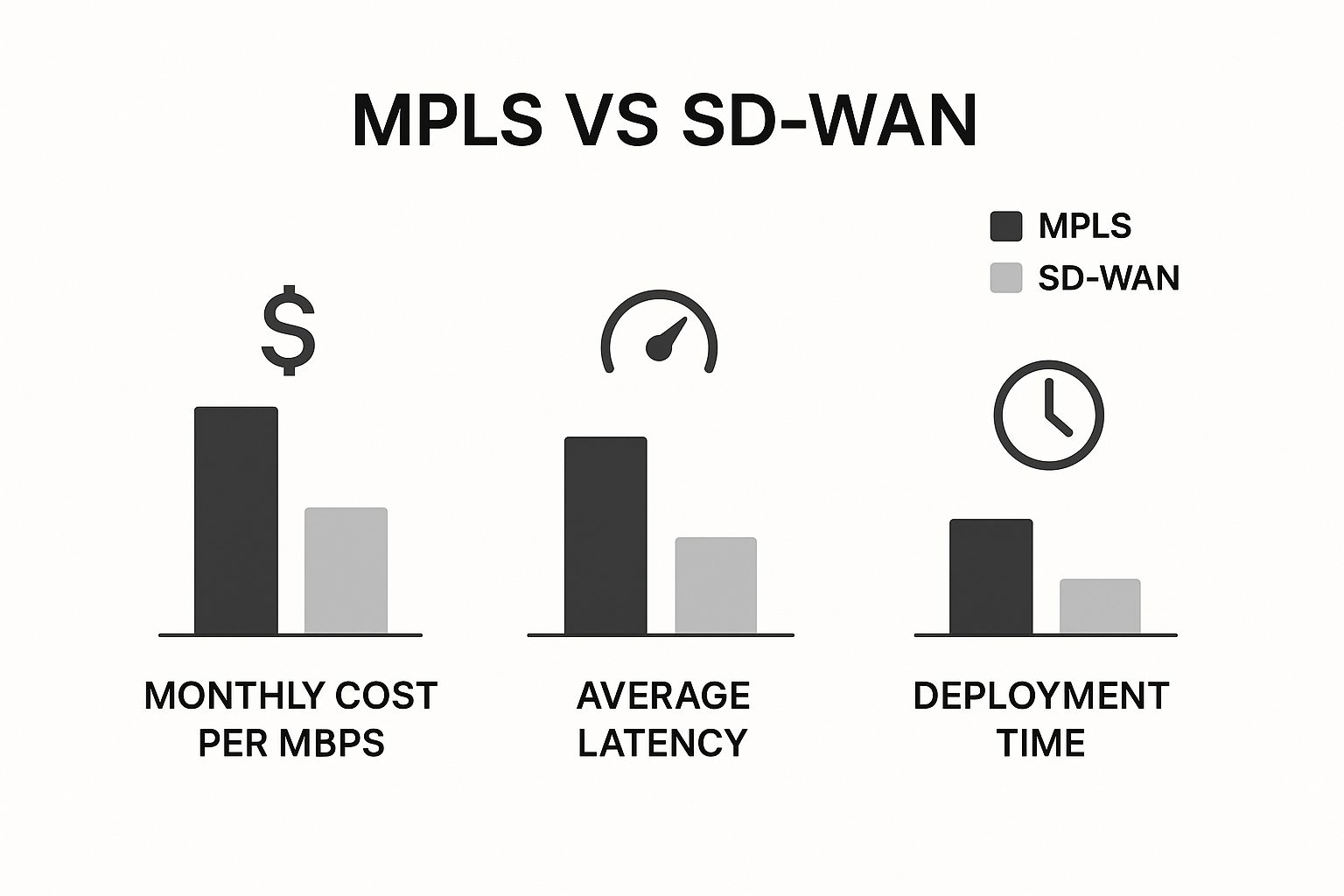
The data is clear. SD-WAN can deliver significant cost reductions and faster time-to-service, making it a powerful alternative for any modern network architecture. Before delving into the specifics of these features, it’s beneficial to understand the fundamental deployment models. If you require a primer, our guide covering the essentials of SD-WAN is an excellent resource.
Quick Guide to SD-WAN Deployment Models
Choosing a deployment model is a critical initial decision. It dictates the degree of control you retain versus the operational burden you offload to a partner. This table breaks down the primary options to help you align a model with your team’s technical expertise and business requirements.
| Deployment Model | Management & Control | Ideal Use Case | Key Advantage |
|---|---|---|---|
| DIY (Do-It-Yourself) | Full in-house control via vendor portal | Organizations with strong, dedicated network engineering teams | Maximum customization and policy control |
| Co-Managed | Shared responsibility between in-house IT and a service provider | Teams needing expert support for complex tasks but retaining daily control | Balances internal expertise with external specialized support |
| Fully Managed | Completely outsourced to a Managed Service Provider (MSP) | Businesses without specialized IT staff or those focusing on core operations | Minimal operational overhead and guaranteed SLAs |
Ultimately, the optimal model depends entirely on your internal resources. A DIY approach offers granular control but requires a deep talent pool. A fully managed service, conversely, allows you to focus on core business functions while an expert manages the network. The co-managed model offers a practical middle ground for many organizations.
Comparing Core SD-WAN Architectural Features

When attempting to identify the right SD-WAN solution, it is easy to become overwhelmed by feature lists. To truly understand the platform, you must look past marketing promises and scrutinize the architectural details. How a platform actually steers traffic, recovers from circuit degradation, and prioritizes critical applications is what differentiates a basic offering from a truly enterprise-grade system.
A vendor might advertise “intelligent pathing,” but the critical question is how their algorithm makes those pathing decisions. A sophisticated solution does not just react to latency and packet loss; it proactively measures jitter and available bandwidth in real-time. This data-driven approach is what guarantees your most critical traffic is always routed over the optimal path.
This continuous monitoring allows the system to be proactive, shifting traffic before a user experiences performance degradation. The best platforms provide the engineering team with full visibility into these metrics, so you can validate precisely why a certain path was selected for a specific application flow.
Dynamic Path Selection and Failover Mechanisms
The core of any credible SD-WAN is its dynamic path selection engine. This is the intelligence that steers application traffic across your diverse WAN links—be it MPLS, broadband, or 4G/5G—based on defined policies and the real-time health of those connections. The level of sophistication here varies significantly among providers.
For instance, a basic solution might offer simple failover. When the primary link fails, all traffic is re-routed to the backup. A more advanced architecture, in contrast, can detect “brownout” conditions—where a link is degraded but not completely down—and preemptively move critical application sessions without dropping them. This is what mitigates performance issues when a circuit experiences high latency or packet loss.
When engaging with vendors, demand specifics about their failover and failback logic. The key differentiator to probe for is hitless failover. This capability ensures that a VoIP call or video conference continues without interruption during a link transition.
Equally crucial is the failback process. Once the primary link is restored and stable, a superior system will gracefully and automatically revert traffic. This ensures you are always utilizing the most cost-effective or highest-performing link available. This type of automated traffic engineering is the foundation of a resilient and efficient network.
Application-Aware Routing and Traffic Policies
In a modern enterprise network, not all traffic is equal. An SD-WAN’s ability to identify and prioritize applications is not just a feature; it is essential for delivering a quality user experience (QoE). This capability must extend beyond legacy port and protocol-based classification. It requires deep packet inspection (DPI) to identify thousands of applications, even those using encryption.
The true test of a platform’s intelligence is how it uses this application awareness to enforce business policies. Can you easily construct a policy that routes all your Microsoft 365 traffic over a low-latency fiber connection while directing bulk data backups to a high-bandwidth, lower-cost broadband circuit?
Consider a real-world retail scenario:
- Point-of-Sale (POS) Transactions: These are top priority and require the lowest possible latency.
- In-Store Guest Wi-Fi: This is assigned a lower priority and is rate-limited.
- Inventory Database Syncs: These require a reliable connection but can tolerate higher latency.
The best SD-WAN solution provides the capability to create these precise, application-centric policies from a single, centralized orchestration console. This is how you align network resources directly with business priorities, not merely with link availability. The ability to enforce these policies dynamically across hundreds or thousands of sites is what truly delivers consistent application performance and operational efficiency.
SASE vs. Integrated Security: Which Model Fits Your Network?
Security is not an add-on for your wide area network; it is a foundational pillar. When evaluating the best SD-WAN solution, the chosen security architecture is a critical decision. It will dictate your network’s resilience, flexibility, and overall defensive posture for years to come.
This decision primarily comes down to two dominant models. The first is an integrated approach, where the SD-WAN appliance itself incorporates a robust, on-box security stack, often featuring a Next-Generation Firewall (NGFW). The second, Secure Access Service Edge (SASE), treats SD-WAN as a network fabric component of a broader cloud-native framework that converges networking and security into a single, unified service. Let’s analyze the real-world trade-offs.
The All-In-One Integrated Security Stack
An SD-WAN solution with integrated NGFW capabilities offers the advantage of consolidation. By embedding security functions directly into the edge appliance, you can significantly simplify deployment and management at branch locations. This model is well-suited for organizations seeking to streamline their branch hardware footprint and reduce operational complexity.
This all-in-one approach provides a single pane of glass for both networking and security policies, which can significantly reduce operational overhead. For example, a retail business with hundreds of stores can deploy a standardized appliance with a pre-configured security policy, managed entirely from one central orchestrator. It is an effective method for managing large-scale rollouts and ensuring consistent policy enforcement.
However, there is a trade-off, which is typically the depth of security features. While convenient, an integrated NGFW may not possess the same advanced threat detection or specialized services as a dedicated, best-of-breed security platform. Your team must objectively assess whether the built-in stack fully meets your organization’s compliance and risk management requirements.
Embracing the SASE Framework
In contrast, the SASE model decouples the SD-WAN function from the comprehensive security stack. Instead of deploying security in an appliance at the branch, traffic is intelligently steered from the SD-WAN edge to a cloud-delivered security service. This architecture was designed from the ground up for a modern, distributed workforce and cloud-centric application environments.
SASE platforms typically bundle a comprehensive suite of security services:
- Firewall-as-a-Service (FWaaS): Centralized cloud firewalling for all traffic.
- Secure Web Gateway (SWG): Protects users from web-based threats.
- Cloud Access Security Broker (CASB): Provides visibility and control over SaaS application usage.
- Zero-Trust Network Access (ZTNA): Replaces legacy VPNs with modern, identity-based access control.
The core principle of SASE is to bring security closer to the user and the application, regardless of their location. This model is inherently more flexible for supporting remote workers and direct-to-cloud traffic, as policies are enforced consistently whether a user is in the office, at home, or mobile.
This approach offers significant scalability and immediate access to the latest security features delivered from the cloud. For a more detailed analysis of how these elements interoperate, you can learn more about the relationship between SD-WAN and cybersecurity and how to construct a robust defensive strategy. The potential downside? It can introduce complexity if your SD-WAN vendor and SASE provider are different entities, potentially leading to integration challenges.
Practical Application and Key Differentiators
Choosing between an integrated appliance and a SASE architecture depends on your specific use case and existing infrastructure. A company with a strong on-premises data center footprint might find an integrated NGFW model perfectly adequate, especially for securing east-west traffic between internal segments using micro-segmentation.
Conversely, a cloud-first organization with a large remote workforce will almost certainly derive more value from a SASE architecture. This model excels at securing north-south traffic destined for the internet and cloud applications. It also simplifies the implementation of zero-trust network access (ZTNA)—a critical component for securing a network without a traditional perimeter.
Consider a financial services firm with advanced security requirements, such as specialized data loss prevention (DLP) and sandboxing. In that case, service chaining—the ability to route traffic through multiple security functions in a specific sequence—is critical. A SASE framework typically offers a much more powerful and seamless method for chaining these best-of-breed services compared to the more limited capabilities of a single, all-in-one appliance. Ultimately, the correct choice is the one that aligns with your organization’s risk tolerance, operational model, and strategic objectives.
Validating Performance: KPIs and Proof of Concept
When comparing SD-WAN solutions, it is easy to become lost in a sea of feature lists and technical specifications. The focus must shift from a vendor’s architecture on paper to the real-world, measurable outcomes it delivers for your business. A solution has little value if it fails to create a flawless application experience for end-users.
The true test is defining and tracking the right Key Performance Indicators (KPIs) that prove the technology is performing as advertised. This requires looking beyond basic network health metrics. While latency, jitter, and packet loss are important foundational data points, your team must focus on the Quality of Experience (QoE) for your most critical business applications. These are the platforms where even a minor degradation is immediately felt and causes tangible disruption.
You need a solid evaluation framework to objectively measure how well a solution performs under duress, especially when operating over imperfect commodity broadband and cellular links.
Establishing a Performance Baseline
Before you can validate a vendor’s claims, you must baseline your current environment. Start by measuring the end-to-end experience for the applications critical to business operations.
- VoIP and Video Conferencing: For any real-time communication, the Mean Opinion Score (MOS) is the industry standard. A score dropping below 3.5 is unacceptable, resulting in choppy audio, pixelated video, and user frustration.
- Cloud-Native Platforms: For SaaS tools like Salesforce or Microsoft 365, you need to measure application response time (ART). This KPI tracks the delay between a user action and the application’s response, which is a direct reflection of productivity.
- Transactional Systems: For point-of-sale or ERP systems, transaction speed and success rate are paramount. Any introduced latency here can have a direct impact on revenue.
Once you have this baseline data, you can establish clear, data-driven performance targets for your SD-WAN Proof of Concept (PoC). This is how you move from subjective feedback to an objective, apples-to-apples comparison between vendors within your own network environment.
Advanced Performance Optimization Techniques
This is where you can begin to see significant differentiation between SD-WAN providers. A key differentiator is how a solution actively remediates poor network conditions. Two of the most critical technologies to investigate are Forward Error Correction (FEC) and TCP optimization.
Forward Error Correction (FEC) is a proactive technique where the sending device adds a small amount of redundant data to the stream. If packets are lost over an unstable internet link, the receiving device can use this extra data to reconstruct the missing information on the fly, without requiring a retransmission. This is a game-changer for preserving the quality of real-time voice and video streams.
When discussing with vendors, ask how their FEC is implemented. Is it a static, “always-on” tool, or does it adapt dynamically based on real-time packet loss? Adaptive FEC is far more efficient as it avoids wasting bandwidth by adding unnecessary overhead to a clean link.
TCP optimization addresses the inherent inefficiencies of the TCP protocol, particularly over high-latency WAN links. Features like a local TCP proxy can dramatically accelerate performance. By terminating the TCP session at the branch appliance, it can send acknowledgments much faster and boost throughput for large file transfers and data-intensive applications. This can make a significant difference for users located far from the application host.
The impact of these technologies is well-documented. North America is leading the SD-WAN market, and we see organizations like the Cleveland Clinic using Aruba SD-WAN to achieve a 50% improvement in system availability for their critical telehealth applications. On a global scale, enterprises like Schneider Electric have leveraged Cisco SD-WAN to reduce their MPLS costs by 35% while simultaneously improving performance across dozens of countries. With over 70% of enterprise workloads now running outside a traditional data center, these performance-enhancing features are not just optional; they are essential. You can dig deeper into these market shifts by reviewing the latest industry research.
Structuring a Meaningful Proof of Concept
A well-designed Proof of Concept (PoC) is your single most effective tool for cutting through marketing hype and validating performance claims before committing to a contract. A valuable PoC extends far beyond a simple lab test and simulates your real-world production environment.
- Select Representative Sites: Do not just select your corporate headquarters. Choose a few branch locations that represent a true cross-section of your network—one with high traffic volume, one with notoriously poor internet quality, and one with your most demanding power users.
- Define Success Criteria: Use the performance baselines you established as your pass/fail criteria. Be specific. For example: “Maintain a MOS score of 4.0 or higher for all video calls during peak business hours, even over the secondary broadband link.”
- Simulate Failure Scenarios: This is the critical test. Intentionally degrade or unplug one of the WAN links to observe the outcome. How quickly does the solution failover? Does it impact active sessions? A truly “hitless” failover for a VoIP call in progress is the hallmark of a superior platform.
By conducting a structured PoC, you arm yourself with hard data. It proves which solution can effectively support your unique application mix and maintain the high-quality user experience your business requires. This is how you ensure you are selecting the best sd wan solution for your real-world needs, not just the one with the most persuasive sales pitch.
Calculating the True Total Cost of Ownership

When evaluating SD-WAN, the initial quote for licensing or hardware represents only a fraction of the total investment. To find the best sd wan solution for your budget, you must perform a comprehensive analysis to calculate the true Total Cost of Ownership (TCO). This involves accounting for every direct and indirect cost over the platform’s entire lifecycle. It is the only way to make a financially sound decision that aligns your network strategy with long-term business goals.
First, address the capital expenditures (CapEx). You are essentially choosing between procuring physical hardware appliances for each site or deploying virtual appliances (vCPEs) on existing COTS servers or in a public cloud. Physical appliances are straightforward, but a virtualized approach can significantly reduce upfront hardware costs—assuming you have the necessary infrastructure to support them.
Deconstructing Pricing Models
SD-WAN vendors utilize several different pricing models, and the nuances are important. Understanding these is crucial for accurate financial forecasting, especially as your network scales.
A per-site model is often the simplest. You pay a flat fee for each connected branch, making it predictable for businesses with a fixed number of locations. Conversely, a per-user model can be more cost-effective if you have a large, distributed remote workforce where site count is not the most relevant metric.
The most common approach you will encounter is bandwidth-tiered licensing. Here, costs are tied directly to the throughput required at each site. This offers granular control but necessitates accurate capacity planning. Miscalculation can lead to overprovisioning or unexpected upgrade fees.
A critical component of the TCO calculation is quantifying the savings from decommissioning expensive, legacy MPLS circuits. Model this by comparing your current MPLS expenditure against the cost of more affordable broadband and dedicated internet access links that the SD-WAN will aggregate.
This cost-benefit analysis is often where the most significant ROI from an SD-WAN migration is realized. The ability to replace a single, high-cost MPLS line with two or three inexpensive broadband connections not only improves resilience but also delivers immediate and substantial savings on your operational budget.
Factoring in Operational Overhead
The final component of the TCO puzzle is calculating the operational expenditures (OpEx) associated with managing the solution. This is where you must weigh the pros and cons of a do-it-yourself (DIY) deployment versus a fully managed service.
- In-House Management (DIY): This route requires accounting for “soft costs”—the time investment of your network engineering team. You must factor in the hours spent on initial configuration, ongoing policy management, troubleshooting, and training. While you may avoid monthly management fees, the internal resource cost can be substantial.
- Managed Service (MSP): A managed solution offloads that operational burden to a third-party provider for a recurring fee. This provides predictable monthly costs and immediate access to specialized expertise, making it an excellent option for teams lacking deep SD-WAN experience.
The industry is clearly trending toward bundled services that package the technology with the underlying internet connectivity. In fact, total retail revenue from SD-WAN software and connectivity is projected to increase from $21 billion in 2021 to $43 billion by 2025. This shift demonstrates the market’s high valuation of comprehensive offerings that simplify procurement and network management. You can find more details on this trend by exploring the full SD-WAN forecast from Analysys Mason.
By carefully modeling all these direct and indirect costs, you can construct a complete TCO analysis that reveals the true financial impact of your decision.
Building Your Business Case and Implementation Plan
You have completed the technical due diligence. You have the performance data, you have defined your security requirements, and you have completed the TCO analysis. Now, it is time to consolidate this information into a robust business case and a practical implementation plan. This is where you transition from identifying a good SD-WAN to proving you have found the best SD-WAN solution for your company’s specific requirements.
A compelling proposal must extend beyond a mere network upgrade. It must connect the technology to broader strategic goals, showing how SD-WAN acts as an enabler for critical digital transformation initiatives. Frame this project as an investment in business agility and a direct path to greater operational efficiency.
Creating Your Decision Matrix
To ensure the decision-making process is objective and transparent, a decision matrix is an invaluable tool. It is a simple but effective method for mitigating personal bias and providing a clear, data-driven foundation for your final recommendation.
The key is to assign a specific weight to each category based on its importance to your business. For example, a retail company will likely place a much higher weight on connection stability for its POS systems. In contrast, a company with a large remote workforce might prioritize a vendor’s ZTNA capabilities above all else.
Your matrix should score vendors across these essential categories:
- Technical Features: How well do they handle dynamic path selection, application-aware routing, and failover?
- Security Model: How robust is their on-box security stack, or how seamlessly does it integrate with a SASE framework?
- Management & Orchestration: Is the management console intuitive? How deep is the visibility provided by the analytics and reporting?
- Total Cost of Ownership: What is the complete financial picture, factoring in CapEx, OpEx, and MPLS cost avoidance?
- PoC Results: Score the real-world performance against the benchmarks you established for QoE and application response times.
Phased Rollout and Implementation Strategy
After vendor selection, a meticulous, phased rollout is non-negotiable. Attempting a “big bang” cutover is a high-risk strategy that often leads to significant business disruption. A staged deployment minimizes risk and allows your team to acclimate to the new system.
A prudent, common-sense strategy is to begin with a small pilot group of low-risk branch offices. This creates a controlled environment to fine-tune policies and resolve any unforeseen issues before deploying to mission-critical sites.
One feature is an absolute requirement for any deployment at scale: zero-touch provisioning (ZTP). ZTP allows you to ship unconfigured appliances directly to branch locations, where they automatically connect to the central orchestrator and download their configurations. This drastically reduces deployment time and eliminates the need to dispatch skilled technicians to every site.
For more insights on executing a seamless deployment, review our guide on best practices for SD-WAN. Finally, ensure your network operations team receives training early in the process. Their proficiency with the new management platform is critical for long-term success.
Common Questions About SD-WAN Solutions
Even after extensive research, several practical questions often arise just before committing to an SD-WAN project. For the technical teams responsible for implementation and operation, obtaining clear answers to these real-world concerns is what differentiates a smooth deployment from a problematic one. This section addresses the most frequent questions from network engineers and IT leaders.
The objective is to provide direct, technical information to help you overcome final obstacles. We will address the specifics of migrating off legacy MPLS circuits, how to mitigate vendor lock-in, and whether enterprise-grade performance can truly be achieved over public internet links.
How Do We Migrate From MPLS to SD-WAN Without Network Disruption?
The only viable method is a phased, hybrid approach. A “big bang” cutover, where all traffic is switched simultaneously, is ill-advised for most enterprises. The more prudent strategy is to start small. Deploy new SD-WAN appliances at a few pilot branch offices and operate them in a hybrid mode. This allows traffic to flow over both the legacy MPLS circuit and the new internet links concurrently.
From there, you can leverage the SD-WAN’s policy engine to systematically steer non-critical traffic over the new internet connections. This provides your team an opportunity to observe performance and validate policies in a live, yet low-risk, environment. Once you are confident in the stability and performance, you can begin migrating critical applications and schedule the final decommissioning of the MPLS link, all without causing any interruption to business operations.
What Are the Biggest Risks of Vendor Lock-In With SD-WAN?
Vendor lock-in is a significant and tangible risk. It typically manifests in two primary ways: being tied to proprietary hardware and being trapped within a closed, inflexible management ecosystem. Some vendors mandate the use of their specific hardware appliances, which can make future upgrades or architectural changes a costly and complex endeavor.
To mitigate this, prioritize solutions that can operate as virtual appliances on universal CPE (uCPE) or even on standard commercial off-the-shelf (COTS) hardware. Equally critical is an open and well-documented API. A robust API provides integration flexibility, ensuring you can connect the SD-WAN platform to your existing security, monitoring, and automation toolchains instead of being confined to a single vendor’s ecosystem.
Can SD-WAN Truly Deliver Enterprise-Grade Performance Over the Public Internet?
Yes, but only if the solution incorporates the necessary underlying technology. The best SD-WAN platforms do not simply route traffic over the internet and hope for the best. They employ a toolkit of sophisticated features to construct a resilient, high-performance network fabric over commodity links.
Some of the key techniques include:
- Dynamic Path Selection: The system constantly monitors all available ISP links, measuring metrics like latency, jitter, and packet loss, and routes traffic over the optimal path in real time.
- Forward Error Correction (FEC): This is essential for voice and video. It proactively adds redundant data to the packet stream, allowing the receiving end to reconstruct lost packets on the fly without requiring a retransmission.
- WAN Optimization: This involves features like TCP protocol optimization, which helps overcome the inherent latency on long-distance connections and significantly improves throughput.
The critical takeaway is that you must validate this performance in your own environment. A proper Proof of Concept (PoC) is non-negotiable. It is the only way to truly test how a solution performs under your specific, real-world internet conditions before you commit to a long-term contract.
Ready to build a more resilient and cost-effective WAN? Mushroom Networks Inc. provides advanced SD-WAN solutions that bond multiple internet connections—including fiber, cable, 4G/5G, and satellite—into a single, ultra-reliable link. Discover how our broadband bonding technology can optimize your network today.