The difference between 4G and 5G isn’t just a matter of incremental speed increases; it’s a fundamental architectural overhaul. While 4G LTE (Long-Term Evolution) was a transformative leap for mobile broadband, 5G New Radio (NR) represents a completely new framework. It is engineered from the ground up for three distinct classes of service: enhanced Mobile Broadband (eMBB), massive Machine-Type Communications (mMTC), and Ultra-Reliable Low-Latency Communications (URLLC).
To use an analogy, 4G built a reliable multi-lane highway for mobile data traffic. 5G is creating an entire transportation system with specialized, isolated lanes for everything from autonomous vehicle platoons to billions of low-power IoT sensors.
The Core Differences Between 4G and 5G

For IT professionals, the real distinction goes far beyond consumer marketing metrics. 4G LTE truly optimized the mobile internet, making high-quality video streaming and stable remote work a daily reality. It primarily operates on sub-6 GHz spectrum, which offered an excellent balance of throughput and coverage.
5G, on the other hand, was engineered to meet a much broader set of technical requirements. It employs a more flexible spectrum strategy that includes low-band for wide-area coverage, mid-band for a blend of speed and reach, and high-band millimeter wave (mmWave) for multi-gigabit throughput in high-density environments.
While this multi-tiered approach delivers significant performance gains, it also introduces new layers of complexity. In fact, many organizations are still navigating the initial challenges with 5G deployment and determining how to best integrate it into their existing network infrastructure.
From an architectural standpoint, 5G is designed for service-based delivery. This enables network slicing—the ability to create multiple virtual networks on top of a single physical infrastructure, each tailored with specific performance guarantees.
This is the key differentiator for enterprise applications. 4G is a dependable workhorse for general-purpose connectivity. But 5G unlocks capabilities that were previously unachievable over a wireless network. Exploring broader wireless solutions can offer more context on the principles driving these generational shifts in network technology.
4G LTE vs 5G NR At a Glance
The table below breaks down the high-level technical specifications and performance targets for 4G and 5G. It provides a quick reference for just how different their design goals truly are.
| Specification | 4G (LTE-Advanced) | 5G (New Radio) |
|---|---|---|
| Peak Data Rate | ~1 Gbps | 10-20 Gbps |
| User Experienced Data Rate | 10s of Mbps | 100s of Mbps to Gbps+ |
| Latency | 30-50 ms | <10 ms (as low as 1 ms) |
| Connection Density | ~100,000 devices/km² | ~1 million devices/km² |
| Core Architecture | Evolved Packet Core (EPC) | Service-Based Architecture (SBA) |
| Primary Use Cases | Mobile Broadband, VoIP | eMBB, URLLC, Massive IoT |
As the specifications show, the leap from 4G to 5G is less of an evolution and more of a re-architecture of a wireless network’s capabilities—from latency measured in single-digit milliseconds to supporting a million devices per square kilometer.
When you analyze the internals of 4G and 5G, past the headline speed numbers, you find that the real differences lie in their fundamental design—the network architecture and how they utilize the radio spectrum. For IT professionals, understanding these core distinctions is key to grasping why 5G is more than just a faster iteration of 4G.
4G networks were built around the Evolved Packet Core (EPC). This was a fairly centralized architecture that worked brilliantly for the mobile broadband era it powered. With EPC, data routing and management are handled from a central point. While this approach is reliable, it can also create dependencies and potential choke points, limiting its flexibility for future-proof use cases.
5G, on the other hand, was designed from the ground up with a completely different philosophy. It uses a Service-Based Architecture (SBA), a decentralized, cloud-native framework where network functions operate as modular, containerized microservices. This makes the network far more programmable and agile than 4G’s EPC, allowing for dynamic resource allocation and simplified integration of new services.
The Power of Network Slicing
One of the most powerful capabilities unlocked by 5G’s architecture is network slicing. This is a paradigm shift. It allows network operators to provision multiple virtual, end-to-end networks on top of a single physical infrastructure. Each “slice” can be isolated and customized with its own specific characteristics for Quality of Service (QoS), throughput, and latency.
For an enterprise, this means you could have one slice dedicated to high-bandwidth, best-effort employee internet access and a separate, ultra-reliable, low-latency slice for mission-critical industrial IoT controllers—all running on the same 5G infrastructure. This level of granular control was simply not possible with 4G’s monolithic architecture.
Strategic Spectrum Utilization
The other major differentiator is how each generation utilizes radio frequencies. 4G primarily operates on sub-6 GHz frequency bands. This spectrum was a strategic choice, offering a great balance of broad coverage and sufficient capacity. The signals propagate long distances and penetrate buildings effectively, which was critical for achieving widespread adoption.
5G takes a much more sophisticated, three-tiered approach to spectrum to deliver on its promises of speed, capacity, and low latency:
- Low-Band (Sub-1 GHz): This provides a wide coverage blanket, analogous to 4G, ensuring foundational connectivity across vast geographic areas. The speeds here are more of a modest improvement, but the reach is excellent.
- Mid-Band (1-6 GHz): Often called the “sweet spot” band (this includes the popular C-band), it offers a compelling mix of good coverage and a significant throughput increase over 4G, making it ideal for most enhanced mobile broadband applications.
- High-Band (mmWave): Operating above 24 GHz, this is where the transformative speeds are realized. This spectrum offers enormous bandwidth and enables multi-gigabit throughput. The tradeoff is that the signals have an extremely short range and poor penetration through obstacles, limiting its use to dense urban cores, stadiums, and specific enterprise venues.
This technological gap is stark when you look at real-world data. As of Q3 2023, the global median 5G download speed reached 203 Mbps—a significant leap from the 20-50 Mbps typically seen on 4G. This performance jump, along with 5G’s potential for sub-1 millisecond latency, is fueling rapid growth. The U.S. alone hit 176 million 5G connections by late 2023. You can explore more data on the global 5G rollout and its performance statistics.
When you get down to the technical specifics of 4G versus 5G, IT professionals know that theoretical peak speeds are marketing figures. What really matters is how each technology performs in real-world deployments across three core metrics: throughput, latency, and connection density. These are the areas where 5G’s architectural advantages become clear, directly influencing which technology is appropriate for specific business applications.
Speed: More Than Just Megabits Per Second
For years, 4G LTE has been the reliable standard for enterprise mobility. It delivers typical download speeds between 30–100 Mbps, which is sufficient bandwidth for most day-to-day business operations like video conferencing, accessing cloud-based applications, and general mobile workforce connectivity. It’s a known quantity—consistent and dependable in most developed areas.
5G, on the other hand, is not a single performance tier. Its throughput is a direct result of the radio spectrum it’s utilizing.
- Mid-band 5G: This is the most common deployment, offering a substantial upgrade with real-world speeds of 100–400 Mbps.
- High-band mmWave 5G: This is the high-performance tier. Operating on millimeter wave spectrum, it can push past 1 Gbps, making it a viable primary internet connection for an enterprise through Fixed Wireless Access (FWA).
Latency: The Key to Real-Time Operations
Throughput gets the headlines, but for many industrial and time-sensitive applications, latency is the critical metric. Latency is the round-trip time for a packet of data. With 4G, you’re looking at a latency of around 30-50 milliseconds (ms). That was revolutionary for its time, but it’s a non-starter for systems that demand near-instantaneous feedback.
5G was engineered from the ground up to minimize this delay. It targets sub-10ms latency and, under ideal conditions, can dip as low as 1 ms. This near-zero lag is what makes advanced applications like industrial automation, remote robotic surgery, and high-frequency financial trading technically feasible. In these fields, a 50ms delay isn’t just an inconvenience; it’s a critical failure.
If your team is focused on minimizing network response times, you can find some practical strategies on how to reduce network latency across your entire infrastructure.
Density: Supporting a Future of Connected Devices
The final piece of the performance puzzle is connection density—the number of devices that can be simultaneously connected to the network within a given area. This is where the scale of 5G’s design goals really becomes apparent.
- 4G LTE was built for the smartphone era and can support tens of thousands of devices per square kilometer.
- 5G NR (New Radio) was designed for the Internet of Things, capable of supporting up to one million devices per square kilometer.
This order-of-magnitude leap in capacity is essential for the future of smart cities, connected logistics, and industrial-scale sensor networks where everything from traffic lights to shipping pallets requires a network connection.
To put these differences into perspective, here’s a direct comparison of the technical metrics that define each generation’s capabilities.
Technical Performance Metrics 4G vs 5G
This table breaks down the key performance indicators, moving beyond just marketing numbers to show what IT leaders can realistically expect from each network.
| Performance Metric | 4G (LTE-Advanced) | 5G (NR) | Implication for IT |
|---|---|---|---|
| Peak Download Speed | 1 Gbps (theoretical) | 10-20 Gbps (theoretical) | 5G offers fiber-like speeds wirelessly, enabling FWA and massive data transfer. |
| Real-World Speed | 30-100 Mbps | 100 Mbps – 1+ Gbps | 5G provides a significant, noticeable boost for everyday bandwidth-heavy tasks. |
| Latency | 30-50 ms | <10 ms (can approach 1 ms) | The ultra-low latency of 5G unlocks real-time control applications (robotics, AR/VR). |
| Connection Density | Tens of thousands per km² | 1 million+ per km² | 5G is built to support massive IoT deployments without network congestion. |
The takeaway is clear: while 4G remains a solid choice for standard mobile connectivity, 5G introduces a level of performance that fundamentally changes what’s possible for a business.
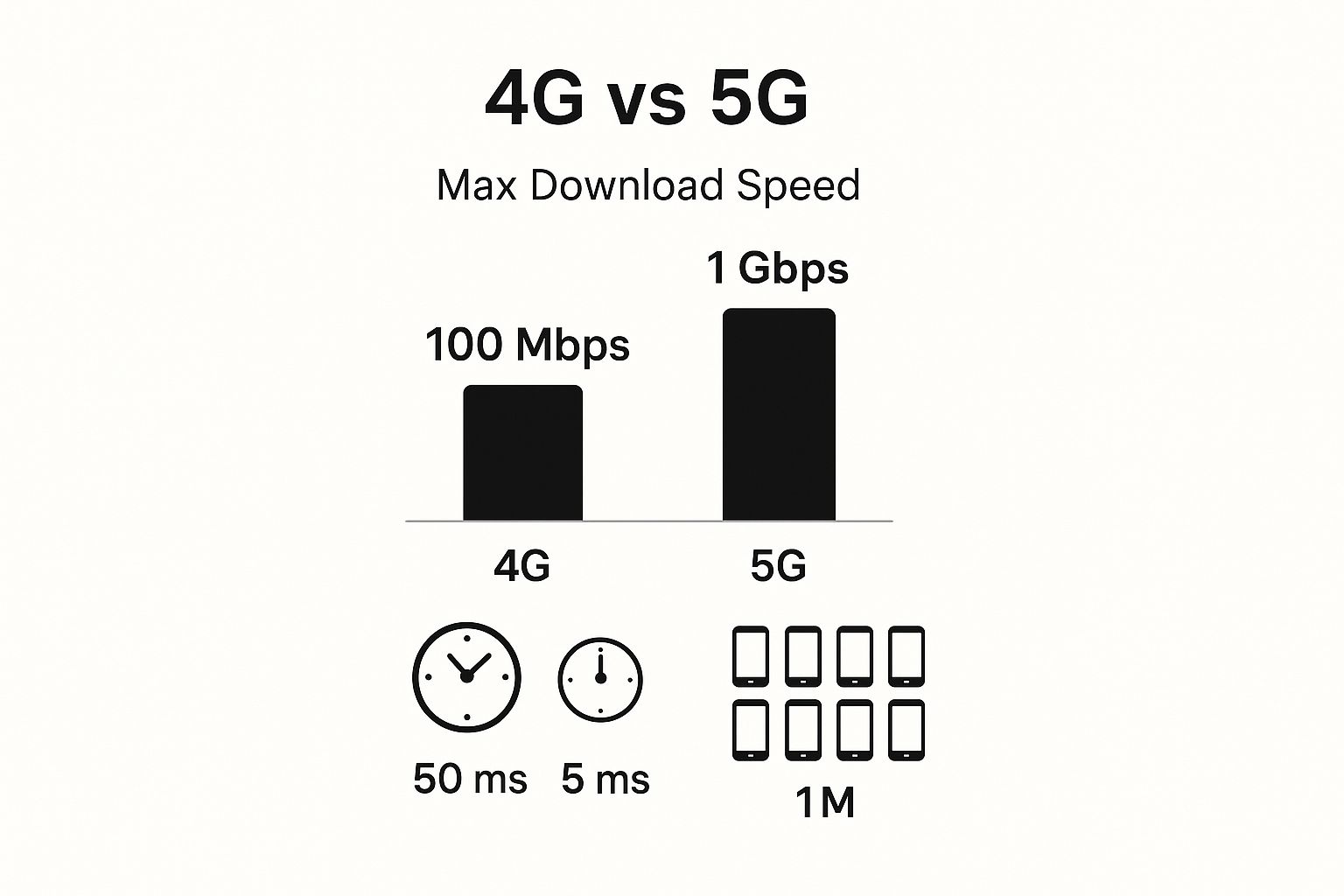
This visualization drives the point home. 5G isn’t just an incremental step up; it’s a tenfold improvement across the metrics that matter. It’s not merely an upgrade—it’s the foundational technology that will support the next wave of business innovation.
Evaluating Security Models and Enhancements
For any IT leader, the conversation about network upgrades always includes a critical evaluation of security. When analyzing 4G vs. 5G, it’s clear that 5G was engineered with a more robust security posture, directly addressing the known vulnerabilities of its predecessor.
4G’s security weaknesses are well-documented. Many are tied to its reliance on the legacy Signalling System No. 7 (SS7) protocol, which handles call and SMS routing. These long-standing flaws expose 4G networks to man-in-the-middle attacks, location tracking, and call interception—creating tangible risks for enterprise communications.
In contrast, 5G’s architecture has security integrated at its core. A significant upgrade is its ability to conceal the International Mobile Subscriber Identity (IMSI).
In a 5G environment, the IMSI is encrypted and masked behind a temporary identifier called the Subscription Concealed Identifier (SUCI). This makes it exponentially more difficult for a threat actor to track a specific device or user on the network, a crucial improvement for protecting sensitive corporate assets and personnel.
Built-in Versus Bolted-on Security
5G’s security philosophy is proactive, not reactive. It integrates controls directly into the network fabric itself, rather than treating them as an add-on.
This “security by design” approach provides defense-in-depth:
- Enhanced Authentication: 5G utilizes a more robust and unified authentication framework, making it far more difficult for unauthorized devices to gain network access.
- Network Slicing Isolation: Each network slice is logically its own isolated, end-to-end virtual network. A security breach on a public, low-priority slice will not compromise a separate, highly secured slice dedicated to critical infrastructure control.
- Integrity Protection: 5G mandates integrity protection for user plane data. This crucial step safeguards data from being tampered with after it has been authenticated by the network.
New Challenges and Expanded Attack Surfaces
Despite these significant improvements, 5G is not a panacea. Its architecture also introduces a new set of security challenges that IT leaders must address. The sheer scale of massive IoT deployments creates an exponentially larger attack surface. Securing millions of low-power, often minimally configured sensors presents a far greater challenge than managing a fleet of corporate smartphones.
As network capabilities grow, so does the sophistication of cyber threats. Staying ahead requires a keen understanding of evolving risks like the rise of AI-driven social engineering. This trend is only accelerated by the rapid consumer shift; back in 2021, 5G smartphones already accounted for 40% of all global sales, a figure set to hit 69% by 2025. This massive adoption highlights the urgent need for security protocols that can scale with this expanding ecosystem.
Business Use Cases and Practical Applications
When we move beyond technical specifications, we can see how 4G and 5G fit into distinct enterprise strategies. For many organizations, 4G LTE is still the workhorse. It’s a proven, pragmatic choice for established applications where reliability and broad coverage are the primary concerns. This includes mobile workforces that require consistent access for video calls, VoIP, and cloud applications in the field.
4G also remains the go-to foundation for many first-generation IoT deployments. These are applications like fleet management trackers or remote asset monitors that transmit small, periodic data packets. For these scenarios, 4G delivers a cost-effective and dependable connection without the performance overhead of newer technologies.
New Applications Unlocked by 5G
5G isn’t just an incremental improvement; it enables entirely new business models and operational efficiencies. Its unique combination of high bandwidth, low latency, and massive device density facilitates applications that were previously impossible with wireless networks. The conversation shifts from supporting mobile teams to reinventing core business processes.
Here are a few key areas where 5G’s capabilities are already making a significant impact:
- Private 5G for Smart Factories: Manufacturers are deploying private 5G networks to leverage Ultra-Reliable Low-Latency Communications (URLLC). This provides them with deterministic wireless control over automated guided vehicles (AGVs), robotic arms, and quality control sensors, finally allowing them to replace failure-prone wired connections on the factory floor.
- Fixed Wireless Access (FWA) as a WAN Link: With throughput that can match or exceed fiber, 5G FWA is now a legitimate WAN option for businesses. It can be used as a primary link in underserved areas, for rapid site deployment, or as a high-speed failover circuit that is physically diverse from terrestrial lines.
- Guaranteed Underlays for SD-WAN: Network slicing allows operators to provision dedicated virtual networks with guaranteed Quality of Service (QoS). This provides SD-WAN deployments with a reliable, high-performance wireless underlay, ensuring critical applications always receive the priority bandwidth and low latency they require.
The ability to combine diverse connection types is a cornerstone of modern network resilience. For IT leaders building robust WAN architectures, understanding the principles behind broadband bonding and WAN optimization provides a framework for integrating 5G alongside other links for maximum uptime and performance.
Aligning Network Choice with Business Goals
Ultimately, the choice between 4G and 5G isn’t about which technology is “better,” but which one is right for the specific application. 4G excels at providing stable, widespread connectivity for the needs of today’s mobile enterprise. It is a mature, well-understood, and highly effective technology for a massive range of use cases.
However, when a business strategy hinges on real-time control, massive data throughput, or supporting a dense ecosystem of connected devices, 5G becomes the clear enabler. It provides the technical foundation for the next wave of industrial automation, immersive customer experiences, and data-intensive edge computing. The key for IT leaders is to map the distinct capabilities of each generation directly to strategic objectives, ensuring network investments drive tangible business value.
Where We Stand: Deployment Status and Migration Paths
Making pragmatic infrastructure decisions requires an objective assessment of the current 4G and 5G landscape. While 5G garners the most attention, 4G LTE remains the dominant cellular connectivity technology. It is a mature, dependable network that often delivers more consistent and predictable coverage than its successor, especially outside of major metropolitan areas.
For IT leaders, this means 4G is far from obsolete; it is a stable foundation. It serves as an essential fallback for 5G connections and is a cornerstone of hybrid strategies like SD-WAN, where multiple links are aggregated for maximum resilience. With 4G, performance is a known quantity.
The Two Faces of 5G Deployment
The transition to 5G is not a binary event. It is a gradual evolution unfolding in two distinct phases, each defined by the core network architecture. Understanding this distinction is critical to setting realistic expectations for performance and feature availability.
- Non-Standalone (NSA) 5G: This is the most prevalent form of 5G currently deployed. NSA utilizes the 5G New Radio (NR) air interface but relies on the existing 4G Evolved Packet Core (EPC) for control plane functions. This configuration delivers the higher throughput of 5G but does not unlock the more advanced, architecturally dependent features.
- Standalone (SA) 5G: This is the full realization of the 5G vision—an end-to-end 5G network running on a dedicated 5G Core (5GC). SA is the only architecture that can deliver transformative capabilities like ultra-low latency (URLLC) and network slicing, as it operates completely independently of any 4G infrastructure.
The transition from NSA to SA is a massive, capital-intensive infrastructure overhaul for carriers. Until SA deployment becomes widespread, the most powerful enterprise use cases for 5G will be confined to specific geographic regions or private network deployments.
One of the most remarkable aspects of 5G is its adoption velocity. By the end of 2024, projections showed 2.25 billion 5G connections globally—a growth rate four times faster than 4G LTE experienced in its early years. This rapid expansion is especially clear in North America, where 5G population coverage reached 77%, a milestone that took 4G much longer to achieve. You can dive deeper into these trends by checking out the full research about 5G adoption rates.
Common Questions from IT Leaders
As network infrastructure evolves, IT leaders are constantly evaluating their options. Here are direct answers to the most common questions regarding the strategic roles of 4G and 5G.
When Should We Choose 5G Over 4G for Primary Connectivity?
The decision hinges on the specific technical requirements of the application. For many standard business operations, the mature 4G LTE network is still the most practical choice. It is ideal for general enterprise mobility, remote access, and foundational IoT deployments where consistent coverage and cost-effectiveness are priorities. It is a known, reliable, and economical solution.
The leap to 5G as a primary link is justified when you encounter specific performance limitations.
- Latency-Sensitive Operations: If you are running industrial controls, robotics, or real-time automation, the sub-20ms latency of 5G is a strict requirement, not a luxury.
- High-Bandwidth Fixed Wireless: When evaluating Fixed Wireless Access (FWA) as a legitimate fiber replacement, 5G is the only wireless technology that can deliver the necessary multi-gigabit throughput.
- Massive IoT Deployments: For use cases like smart factories or warehouses with thousands of sensors in a confined area, 5G is designed to handle this density, supporting up to one million devices per square kilometer. 4G infrastructure would be overwhelmed by this load.
How Does 5G Affect Our SD-WAN and SASE Strategy?
5G is a significant enhancement for both SD-WAN and Secure Access Service Edge (SASE) architectures. It can function as a primary connection with performance rivaling fiber, or it can serve as a high-throughput failover circuit that is physically diverse from any terrestrial cabling.
The most impactful feature for SD-WAN is network slicing. This allows carriers to provision a dedicated virtual network “slice” with guaranteed Quality of Service (QoS). This provides a wireless link with performance assurances previously unattainable on cellular. For SASE, this bolsters the framework by providing a reliable and performant underlay for consistent security policy enforcement and application delivery.
Is 5G More Expensive Than 4G for Business?
Looking solely at monthly data plan costs, 5G can appear more expensive. However, this neglects the Total Cost of Ownership (TCO) and the Return on Investment (ROI) specific to the use case.
The financial model changes dramatically depending on the application. For a private 5G network in a smart factory, the initial capital expenditure is often offset by eliminating costly downtime from wired connection failures and improving production throughput. For a retail branch, deploying 5G FWA can be significantly cheaper than the civil engineering costs of trenching a new fiber line, making it a clear financial and operational win.
For organizations looking to build resilient, high-performance networks, Mushroom Networks Inc. provides advanced SD-WAN solutions that intelligently bond 4G, 5G, fiber, and other connections for unmatched reliability and speed. Learn more at https://www.mushroomnetworks.com.