The primary advantages of SD-WAN for IT professionals are increased architectural agility, significant TCO reduction, and quantifiable performance improvements for distributed, cloud-centric applications. Legacy network models like MPLS are fundamentally inefficient for environments where applications and users are geographically dispersed, and no longer confined to a central data center. SD-WAN provides a logical architectural evolution for any modern IT infrastructure.
Why Modern Network Topologies Require SD-WAN
For years, the “hub-and-spoke” network topology was the standard. All traffic from branch offices (spokes) was backhauled to the central data center (hub) for security inspection and policy enforcement before egress to its final destination. This model was sufficient when applications were hosted on-premises, but it now represents a significant performance bottleneck.
This backhauling architecture is analogous to forcing all city traffic through a single downtown interchange, even for trips between adjacent suburbs. When most destinations—SaaS applications and IaaS/PaaS environments—are external to the data center, this model creates unnecessary latency, degrades the user experience, and inefficiently consumes expensive, dedicated bandwidth.
This fundamental architectural problem is driving a massive industry shift. The global SD-WAN market was valued at USD 2.9 billion in 2021 and is projected to reach USD 30.4 billion by 2030. This growth rate signals the urgent need among enterprises for a more intelligent, flexible, and cost-effective WAN architecture. A full market analysis on Grand View Research details the drivers behind this adoption curve.
The Business Case for SD-WAN
Beyond the technical limitations, legacy network architectures introduce tangible business challenges that SD-WAN is engineered to solve. Adopting a software-defined approach delivers measurable outcomes that resonate with both IT leadership and executive stakeholders.
Key business-level advantages include:
- Operational Agility: Provisioning a new branch office can be reduced from weeks or months to days or even hours. Network-wide policies can be deployed and modified from a centralized control plane.
- Improved User Experience: Application performance is enhanced by mitigating latency. SD-WAN intelligently routes traffic directly to cloud applications, resulting in increased employee productivity.
- Strategic Cost Reduction: Organizations can augment or replace expensive, rigid MPLS contracts with more cost-effective transport options like broadband, fiber, or 5G/LTE without compromising on reliability or security.
To fully appreciate these differences, a direct technical comparison is necessary.
Traditional WAN vs. SD-WAN: A Technical Snapshot
The following table contrasts the core technical and operational distinctions, highlighting how SD-WAN re-engineers the WAN for modern requirements.
| Feature | Traditional WAN (MPLS) | SD-WAN |
|---|---|---|
| Traffic Routing | Static, pre-determined paths based on router configuration. | Dynamic, application-aware routing that chooses the best path in real-time. |
| Management | Complex, device-by-device CLI configuration. | Centralized, GUI-based controller for network-wide policy management. |
| Circuit Type | Relies on expensive, private MPLS circuits from a single carrier. | Transport-agnostic; can bond multiple affordable connections (Broadband, 5G, LTE). |
| Cloud Access | Inefficient backhauling to a central data center for cloud app access. | Direct and secure cloud on-ramps from any branch. |
| Deployment Time | Slow; can take weeks or months to provision a new circuit. | Fast; zero-touch provisioning allows for deployment in minutes or hours. |
| Security | Centralized at the data center firewall, leaving branches vulnerable. | Integrated, distributed security stack (e.g., NGFW, SASE) at the network edge. |
The evolution is clear: from a rigid, hardware-centric model to a flexible, software-defined architecture optimized for the cloud-first enterprise.
This infographic illustrates how these technical advantages translate into direct business impact.
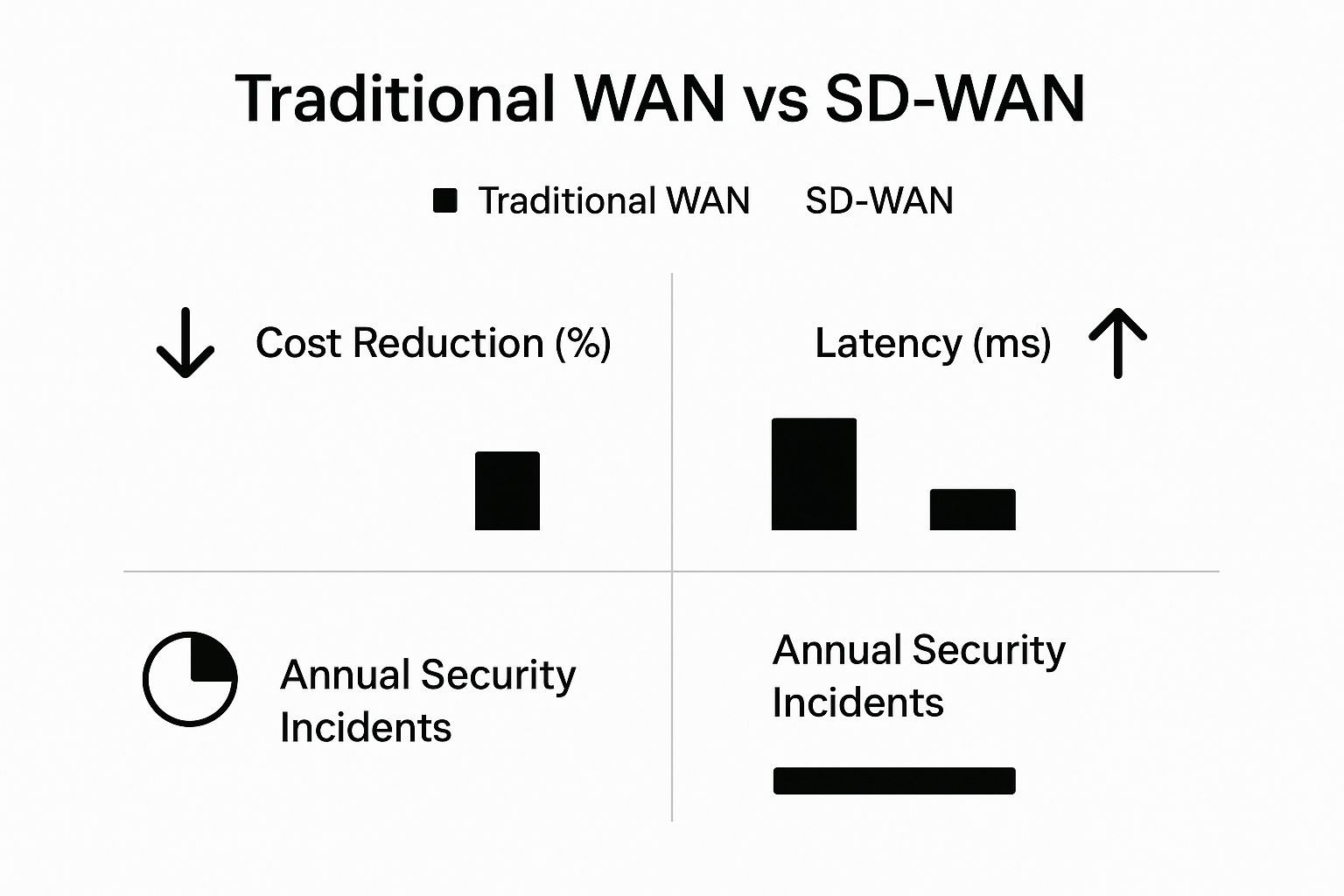
The data clearly shows that SD-WAN implementation correlates with reduced operational costs and latency, while significantly improving the organization’s security posture—a multifaceted technical victory.
2. Unlocking Superior Application Performance

For IT professionals, maintaining application performance is a baseline requirement, not just a goal. SD-WAN is specifically engineered to address this, mitigating common network impairments like latency, jitter, and packet loss to deliver a superior and more consistent user experience.
A traditional WAN operates like a single-lane road; all traffic, regardless of its priority or sensitivity, is funneled through the same path. In contrast, SD-WAN functions as a sophisticated, automated traffic management system. It continuously monitors the real-time health of all available transport paths—be they MPLS, broadband, or 5G—measuring key performance indicators.
This real-time path awareness enables dynamic path selection. For example, if a critical VoIP call traversing a broadband link experiences a sudden increase in jitter, the SD-WAN fabric can reroute that specific traffic flow to a more stable connection, often before the end-user perceives any degradation in call quality. This automated, sub-second failover capability is what makes the network inherently resilient.
How Application-Aware Routing Works in the Real World
SD-WAN elevates traffic management with application-aware routing. Instead of processing traffic based solely on IP addresses and ports, the platform identifies applications using deep packet inspection (DPI) and other techniques. It can differentiate between a latency-sensitive video conference and a bulk file backup.
This capability has profound implications for daily operations, allowing IT to define and enforce business-intent policies.
- Priority Traffic: Ensure mission-critical SaaS traffic (e.g., Microsoft 365, Salesforce) is always routed over the path with the lowest latency and packet loss.
- Best-Effort Traffic: Route less time-sensitive activities, such as bulk data transfers or non-critical web browsing, over lower-cost commodity internet connections.
This intelligent prioritization is a key factor in the SD-WAN market’s projected growth past USD 12 billion by 2025. Enterprises recognize the value of a network that can align its behavior with operational priorities.
SD-WAN moves beyond basic packet forwarding. It enables policy creation based on business intent, ensuring critical applications receive the network resources they require, dynamically and automatically.
This application-centric approach also enhances availability. By actively utilizing multiple internet connections simultaneously, organizations gain intrinsic redundancy. The failure of a single link results in zero downtime for end-users. For a detailed exploration of this mechanism, review the role of SD-WAN in reducing network downtime.
Weaving Robust Security into the Network Edge
A significant architectural advantage of SD-WAN is its ability to integrate security functions directly into the network fabric, distributing policy enforcement from a centralized data center to the network edge. This model is a stark contrast to traditional architectures where security was often a bolted-on, centralized function.
The legacy approach of backhauling all branch traffic to a central firewall for inspection is not only a performance bottleneck but also creates a significant attack surface and security blind spots. SD-WAN inverts this model by distributing security capabilities directly to the point of connection, providing a more robust defense against modern threats.
This integrated security model is a primary driver for SD-WAN adoption. By consolidating encrypted transport, firewalling, and access control into a single platform, IT can significantly mitigate risks associated with a distributed workforce and direct-to-cloud access. More information on this unified approach is available from how SD-WAN delivers a unified security posture from 1800 Office Solutions.
Creating a Consistent Security Stance Everywhere
A major challenge in managing legacy WANs is maintaining policy consistency across hundreds of disparate locations, each with its own hardware stack. This often involves cumbersome, manual, and error-prone configuration processes. SD-WAN solves this by converging multiple security functions into a single, centrally managed platform.
Key security capabilities typically integrated into an SD-WAN solution include:
- Next-Generation Firewall (NGFW): Provides application-aware traffic inspection and advanced threat prevention directly at the branch.
- Secure Web Gateway (SWG): Enforces corporate internet access policies and protects users from web-based threats, regardless of their location.
- Micro-segmentation: Enables the creation of isolated network zones to contain lateral movement in the event of a breach, thereby limiting the blast radius of an attack.
The core operational benefit is the ability to manage these functions from a single orchestrator. A unified, network-wide security policy can be deployed to all locations in minutes, dramatically reducing administrative overhead and the potential for human error.
This is more than an operational simplification; it represents a strategic shift towards a modern security architecture. For many organizations, implementing SD-WAN is a foundational step towards a full Secure Access Service Edge (SASE) framework.
SASE represents the convergence of networking and security as a single, cloud-delivered service. It combines the network intelligence of SD-WAN with a comprehensive, cloud-native security stack, creating a flexible and powerful architecture designed for the modern distributed enterprise.
Streamlining Network Management and Operations

One of the most praised advantages of SD-WAN among network engineers is the radical simplification of day-to-day network management. Legacy WAN administration involved connecting to individual routers via CLI, a time-consuming and non-scalable process for implementing even minor policy changes.
SD-WAN abstracts this complexity into a centralized management controller. This provides network teams with a single-pane-of-glass dashboard for complete visibility and control over the entire WAN fabric. From this central orchestrator, engineers can deploy security policies, prioritize applications, and monitor the real-time health of every circuit across the enterprise. This is a significant paradigm shift from the siloed, device-by-device management model of the past.
From Manual Labor to Automated Workflows
The operational impact is most evident during new site deployments. Zero-touch provisioning (ZTP) enables an SD-WAN appliance to be shipped directly to a new site. A non-technical person on-site can connect it to power and an internet link, and the device will automatically contact the central controller to download its full configuration. This eliminates the need for a senior network engineer to be physically present, drastically reducing deployment times and associated travel costs.
This level of automation directly enhances operational efficiency and reduces risk. By abstracting repetitive manual configuration tasks, the probability of human error—a leading cause of network outages—is significantly minimized. To maximize these benefits, it is crucial to adhere to established best practices for SD-WAN deployment.
SD-WAN frees highly skilled technical staff from routine network maintenance and troubleshooting. Instead of spending their time on device-level configuration management, they can focus on strategic initiatives that deliver business value.
This operational efficiency aligns with broader business goals. By applying these principles, organizations can leverage their IT infrastructure as a driver for the kind of improvements detailed in these tips to improve operational efficiency.
Reducing TCO with Smarter Connectivity
A primary driver for SD-WAN adoption is its direct and measurable impact on Total Cost of Ownership (TCO). For decades, enterprise IT budgets were constrained by expensive and inflexible Multiprotocol Label Switching (MPLS) circuits, as few reliable alternatives existed.
SD-WAN introduces the concept of transport independence, which means the network overlay is abstracted from the underlying physical transport. This allows organizations to build a more intelligent and resilient WAN by integrating and managing multiple connectivity types—including cost-effective business broadband, LTE, and 5G—alongside or in place of traditional private lines.
This does not mandate the complete elimination of MPLS. The intelligence of the SD-WAN platform allows for policy-based routing based on application criticality. Less critical traffic can be offloaded to lower-cost broadband links, while reserving the guaranteed performance and SLAs of MPLS for the most mission-vital applications. This pragmatic, hybrid-WAN strategy can significantly reduce monthly circuit expenditures without compromising on performance.
Beyond Bandwidth: The Soft Savings
The cost benefits extend beyond circuit costs. SD-WAN also drives substantial operational savings—the “soft” savings that compound over time and contribute to a lower TCO.
These operational efficiencies manifest in several key areas:
- Simplified Management: The centralized orchestrator dramatically reduces the man-hours required for network configuration, troubleshooting, and policy updates across distributed locations.
- Fewer Truck Rolls: Zero-touch provisioning allows for remote deployment of new branch hardware, eliminating the significant cost of sending senior engineers on-site for installations.
- Device Consolidation: A modern SD-WAN appliance often integrates the functionality of a router, firewall, and WAN optimization controller into a single hardware unit. This reduces capital expenditure, power consumption, and maintenance overhead.
By blending multiple transport types and automating management, SD-WAN offers a clear path to reducing operational expenditure (OpEx). This intelligent network model is also a prerequisite for enhancing cloud connectivity with SD-WAN, empowering IT managers to further optimize performance and cost across their entire infrastructure.
Common Questions About SD-WAN Advantages
Even with a clear understanding of the benefits, experienced IT professionals have practical questions before committing to a new network architecture. Here are answers to some of the most common technical inquiries.
Can SD-WAN Completely Replace My MPLS Circuits?
While it is technically feasible to run a WAN entirely on public internet connections, the most common and pragmatic strategy is a hybrid WAN approach. Think of it as using a specialized, high-precision tool for critical tasks and a versatile, general-purpose tool for everything else.
Organizations can retain a premium MPLS circuit for applications with stringent uptime and performance requirements, such as real-time financial transactions or sensitive healthcare data. All other traffic—including SaaS access, web browsing, and data backups—can be intelligently routed over more economical broadband, fiber, or 5G links. The SD-WAN platform acts as the control plane, dynamically routing traffic based on predefined business policies. This provides the optimal balance of guaranteed performance for critical traffic and significant cost savings.
How Does SD-WAN Improve the Experience for Remote Workers?
For a distributed workforce, SD-WAN provides a transformative improvement. In a traditional VPN model, a remote user’s traffic is often backhauled through a corporate data center before egressing to the internet. This “tromboning” or “hairpinning” introduces significant latency, degrading the performance of cloud and SaaS applications like Microsoft 365 or Salesforce.
SD-WAN resolves this by enabling a direct and secure cloud on-ramp from the user’s location.
Instead of routing traffic through a centralized data center, the SD-WAN architecture provides a direct path to its destination. This dramatically reduces latency and delivers an application experience for remote users that is on par with being physically connected to the corporate LAN.
This is not a minor optimization; it is a fundamental architectural improvement that directly boosts productivity for the entire distributed workforce.
Is Implementing SD-WAN a Complex and Disruptive Process?
While any network migration requires careful planning, modern SD-WAN solutions are designed to minimize deployment complexity and disruption. The key enabling feature is zero-touch provisioning (ZTP).
The ZTP workflow is as follows: an administrator pre-configures the policies for a new branch location in the central orchestrator. An SD-WAN appliance is then shipped to the site. A local, non-technical person simply connects the device to power and an internet link. The appliance will then automatically:
- Establish a secure connection to the central controller.
- Download its specific configuration profile and security policies.
- Securely integrate itself into the corporate WAN.
This process transforms a potentially multi-day, expert-level installation into a plug-and-play exercise. It drastically reduces deployment timelines, eliminates the cost of dispatching IT personnel to remote sites, and accelerates the process of bringing new locations online.
Does SD-WAN Work with My Existing Security Tools?
Yes. While many leading SD-WAN platforms include robust native security features like a next-generation firewall (NGFW), they are designed for interoperability. A “rip and replace” of your existing security stack is not required.
Through features like service chaining and open APIs, an SD-WAN solution can be configured to intelligently steer specific traffic flows to existing third-party security services. This means organizations can continue to leverage their investments in specialized cloud security gateways (e.g., CASB, SWG) or on-premises security appliances that their teams already manage. This flexibility allows for the creation of a best-of-breed, secure, and agile network edge without abandoning established security investments and operational workflows.
Ready to unlock these advantages for your own network? The team at Mushroom Networks Inc. specializes in building high-performance, resilient, and secure SD-WAN solutions that combine multiple internet connections for superior reliability. Explore how our advanced broadband bonding and SD-WAN capabilities can transform your network.