A software-defined WAN (SD-WAN) architecture disaggregates the network control plane from the data plane, enabling centralized, policy-based management of traffic routing across multiple transport types. This separation facilitates greater network agility, optimized performance for cloud-based applications, and significant cost efficiencies compared to traditional, hardware-centric wide-area networks.
Why Modern Networks Are Moving Beyond Traditional WAN
For decades, Wide Area Networks (WANs) were built on a relatively static and predictable model. A traditional WAN, particularly one leveraging Multiprotocol Label Switching (MPLS), operates like a private railway system. It offers high reliability and security for transporting network traffic from a branch office (Point A) to a central data center (Point B) over dedicated, private circuits.
This model was effective when all critical enterprise applications and data resided within the corporate data center. However, the modern enterprise operates in a distributed environment where applications have migrated to IaaS and SaaS clouds, teams are geographically dispersed, and data is in constant transit.
The Rigidity of Legacy Architectures
The legacy railway model cannot meet the dynamic demands of today’s digital business. For instance, when an employee at a branch needs to access a cloud application (Point C), a traditional MPLS-centric design forces that traffic to be backhauled to the central data center for security inspection before being routed to its final internet destination.
This inefficient process, known as traffic backhauling, creates the “trombone effect.” Data traverses a long, circuitous path, introducing significant latency that degrades the performance of real-time applications like VoIP, video conferencing, and mission-critical SaaS platforms.
This outdated architecture presents several critical challenges for IT leaders:
- High Costs: MPLS circuits are notoriously expensive. Scaling bandwidth to accommodate cloud application traffic volumes can be cost-prohibitive.
- Lack of Agility: Provisioning a new branch office or implementing a network policy change with MPLS can take weeks or months, impeding business velocity.
- Poor Cloud Performance: Traffic backhauling is a performance bottleneck, degrading the user experience for the very cloud services intended to enhance productivity.
The Shift to Intelligent Networking
This is precisely where a software-defined WAN architecture introduces a paradigm shift. Instead of a fixed railway, SD-WAN functions like an intelligent, application-aware GPS for network traffic. It continuously analyzes the real-time performance of all available transport paths—MPLS, broadband internet, 5G, LTE—and makes dynamic routing decisions.
A modern SD-WAN identifies application traffic and intelligently steers it over the most optimal path based on predefined policies. This allows mission-critical business traffic to traverse a high-performance link, while less-sensitive bulk traffic can be routed over a more cost-effective internet connection.
This represents a fundamental rethinking of network design. It aligns network capabilities with the realities of modern business, where application performance, operational agility, and cost optimization are paramount.
Before examining the architectural components, a side-by-side comparison illustrates the key differences.
Traditional WAN vs. SD-WAN At a Glance
| Attribute | Traditional WAN (e.g., MPLS) | Software-Defined WAN (SD-WAN) |
|---|---|---|
| Primary Focus | Connecting branches to a central data center | Connecting users to applications, wherever they are (cloud, data center) |
| Traffic Routing | Fixed, predetermined paths based on circuit | Dynamic, real-time path selection based on policies and performance |
| Management | Complex, device-by-device CLI configuration | Centralized, software-based control from a single management plane |
| Cost | High, based on expensive private circuits | Lower, utilizes a mix of transport types including affordable broadband |
| Agility | Low; slow to deploy and make changes (weeks/months) | High; rapid deployment and policy changes (minutes/hours) |
| Cloud Access | Inefficient; traffic is backhauled through the data center | Direct and optimized cloud access from the branch (local breakout) |
| Security | Centralized at the data center firewall perimeter | Distributed, integrated security stack (e.g., SASE) |
The market’s rapid adoption of this model underscores its value. The global SD-WAN market, valued at approximately $2.9 billion in 2021, is projected to reach $30.4 billion by 2030. This significant growth, detailed in reports covering the SD-WAN industry landscape on grandviewresearch.com, reflects a clear industry-wide migration from legacy constraints toward a more intelligent, flexible, and business-aligned networking paradigm.
Understanding the Core Architectural Components
To fully grasp a software defined WAN architecture, one must look beyond high-level benefits and analyze its fundamental building blocks. The architecture is a coordinated system of specialized components: the edge devices that forward traffic, the centralized orchestrator for management, and the controller that serves as the policy and routing brain. Each component has a distinct function, but they operate in unison to create an intelligent, automated, and responsive network fabric.
At the heart of any SD-WAN deployment are three key elements:
- The SD-WAN Edge (the data plane)
- The SD-WAN Orchestrator (the management plane)
- The SD-WAN Controller (the control plane)
This diagram illustrates how these components and their corresponding planes interoperate.
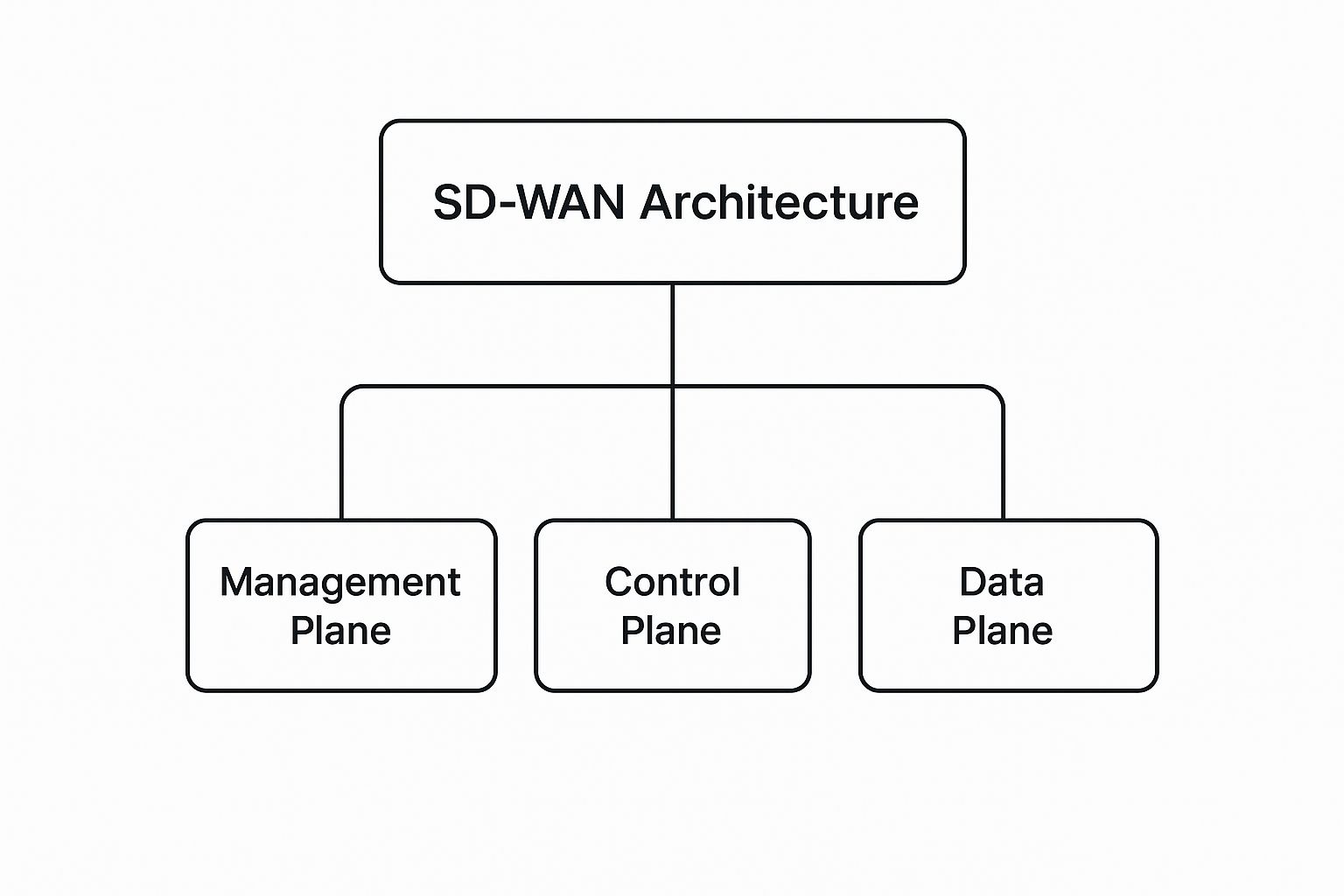
A clear architectural hierarchy is visible. The Management and Control Planes dictate traffic flow policies to the Data Plane below. This fundamental separation of functions is the core principle that enables SD-WAN’s capabilities.
The SD-WAN Edge: The On-Site Enforcer
The SD-WAN Edge is the hardware appliance or virtual function that resides at physical locations, such as branch offices, remote sites, or data centers. Often referred to as Customer Premises Equipment (CPE), this is the component that constitutes the network’s data plane. Its primary function is to execute the traffic-forwarding rules and policies received from the control plane.
The Edge device is more than a simple router. It is responsible for forwarding data packets and may be a dedicated physical appliance, like those from Mushroom Networks, or a virtual network function (VNF) running on standard x86 servers or within a cloud environment.
The Edge continuously monitors the health of all connected circuits—MPLS, broadband, 5G, etc.—measuring metrics like latency, jitter, and packet loss. Based on instructions from the Controller, it dynamically steers traffic over the optimal path. If a link’s performance degrades, the Edge device executes an immediate failover to a better-performing link.
The SD-WAN Orchestrator: Central Command
The SD-WAN Orchestrator functions as the centralized management plane for the entire WAN. It provides the single pane of glass—a unified dashboard—where IT teams configure, deploy, and monitor all elements of the network. This is where network administrators define the high-level business and security policies that govern traffic behavior.
For example, an administrator can use the Orchestrator to define policies such as:
- All real-time VoIP and video traffic must use the link with latency below 50ms.
- Traffic destined for Salesforce.com should be broken out directly to the internet at the branch.
- Bulk data backup traffic should be routed over the lowest-cost broadband connection.
The Orchestrator serves as the human-machine interface for the entire software defined wan architecture. It translates business intent into network configuration, abstracting away the device-by-device command-line interface (CLI) management characteristic of traditional networking. This centralized approach significantly reduces configuration errors and accelerates deployment times.
Once policies are defined in the Orchestrator, they are passed to the Controller for translation into actionable routing intelligence.
The SD-WAN Controller: The Network Brain
While the Orchestrator is the management interface, the SD-WAN Controller is the network’s cognitive engine—the core of the control plane. The Controller ingests the high-level policies from the Orchestrator and correlates them with real-time telemetry data received from every Edge device across the network.
It continuously analyzes link latency, jitter, packet loss, and available bandwidth. Using this stream of data, it calculates the optimal path for every application flow and distributes this routing intelligence back to the Edge devices.
This continuous feedback loop is what makes the network “software-defined” and intelligent. The Controller ensures the entire network fabric adapts dynamically to changing conditions without manual intervention. The interplay between the Edge, Orchestrator, and Controller transforms a collection of disparate circuits into a single, cohesive, and application-aware network.
How Separating the Control and Data Planes Works
The core innovation within any software defined WAN architecture is the clean separation of the network’s control plane (decision-making) from its data plane (packet forwarding). In traditional networking, each router operates autonomously, making routing decisions based on limited information from its direct peers. This creates a rigid, decentralized system that is complex to manage and slow to adapt.
SD-WAN inverts this model by decoupling the Control Plane (the centralized intelligence) from the Data Plane (the distributed hardware that forwards packets).
This is analogous to an air traffic control system. A central tower—the Control Plane—maintains a complete, real-time view of all runways, weather conditions, and flight paths. It makes intelligent, high-level decisions and issues clear instructions to each aircraft. The airplanes themselves—the Data Plane—do not need to compute the entire route; their function is to execute the tower’s directives and transport passengers to their destination safely and efficiently.
This architectural separation is what grants SD-WAN its agility and enables centralized policy enforcement.
The Role of the Centralized Control Plane
The Control Plane is the strategic nerve center of the WAN. This centralized intelligence, often hosted in the cloud or a head-end data center, maintains a holistic view of the entire network fabric. It constantly ingests telemetry data from every edge device, providing a real-time health assessment of every transport link—MPLS, broadband, 4G/5G, or satellite.
At any given moment, the control plane has precise metrics on latency, jitter, and packet loss for every possible path. Armed with this data and the business policies defined in the orchestrator, the Control Plane executes its key responsibilities:
- Calculating Optimal Paths: It determines the most suitable route for each application based on policy and real-time network conditions. For a mission-critical VoIP call, it will identify the most stable, lowest-latency path available.
- Distributing Routing Intelligence: Once the optimal path is determined, the Controller disseminates these routing instructions to the SD-WAN edge devices at each location.
- Enforcing Security Policies: It ensures consistent security policies are applied network-wide, regardless of user location or connection type.
This centralized model obviates the need to configure individual routers at each branch. A policy, such as “All Microsoft 365 traffic should use direct internet access,” is defined once and instantly propagated to every device in the network.
The core function of the Control Plane is to transform high-level business intent into low-level network forwarding rules. This abstraction is what makes the network programmable and automated, freeing IT teams from tedious manual tasks.
This simplification has profound implications for modern enterprises. The cloud-centralized management model of SD-WAN enables organizations to securely connect users to applications with greater efficiency and cost-effectiveness than legacy WANs. The global shift to remote work and accelerated cloud adoption has intensified the demand for agile, high-performance connectivity, fueling a surge in SD-WAN deployments. You can explore more about how these trends are driving market growth in this detailed report on globenewswire.com.
The Function of the Distributed Data Plane
While the Control Plane provides the intelligence, the Data Plane performs the packet forwarding. The Data Plane consists of all the SD-WAN edge devices—physical or virtual appliances—located at branches, data centers, and cloud on-ramps. These devices are the “muscle” responsible for executing the forwarding decisions received from the Controller.
The primary function of the Data Plane is to move packets as quickly and efficiently as possible based on those instructions. This model provides two significant performance advantages.
First, traffic no longer needs to be backhauled to a central data center for policy enforcement. The edge devices are intelligent enough to make local breakout decisions. When a branch user accesses a cloud application like Salesforce, the local device, guided by the Controller’s intelligence, can send that traffic directly to the internet over the optimal available link.
Second, because the edge device constantly monitors all its active paths, it can react instantly to changing network conditions. If the primary broadband link for a video conference suddenly experiences high packet loss, the Data Plane can reroute that session to a more stable 5G link in sub-seconds, often without the user noticing any disruption. This dynamic path selection is a core capability of the software defined WAN architecture that makes it superior for real-time applications.
Choosing Your SD-WAN Deployment Model
After understanding the core components and logic of a software defined wan architecture, the next critical step is selecting a deployment model. The optimal choice depends on an organization’s in-house technical expertise, budget structure (CapEx vs. OpEx), and strategic objectives. This decision dictates the balance between administrative control and operational convenience.
The decision fundamentally involves a trade-off: how much management responsibility does the IT team wish to retain versus how much to offload to a third-party specialist? There are three primary deployment models: a DIY on-premises approach, a flexible cloud-enabled model, and a fully managed SD-WAN as a Service.

The DIY On-Premises Model
The “Do-It-Yourself” (DIY) on-premises model provides maximum control over the network architecture. In this scenario, the enterprise purchases SD-WAN appliances and software licenses directly from a vendor and assumes full responsibility for deploying, configuring, and managing the entire solution. This includes hosting the orchestrator and controller components within its own data centers.
This model is best suited for large enterprises with deep networking expertise and specific, often complex, security or compliance requirements. Organizations needing to deeply customize the solution and integrate it tightly with existing internal systems will find the DIY model offers the necessary control.
However, this control comes at a cost. It requires a significant upfront Capital Expenditure (CapEx) for hardware and software, plus the ongoing operational expenditure (OpEx) of dedicating skilled personnel to manage and maintain the infrastructure.
The Cloud-Enabled Model
The cloud-enabled or hybrid model offers a balance between DIY and fully managed solutions. This popular approach involves the SD-WAN vendor hosting and managing the control and management planes (orchestrator and controller) as a cloud service. The enterprise is responsible for purchasing and deploying the physical or virtual edge appliances at its sites.
This model significantly simplifies deployment and management. The IT team uses a cloud-based portal to define policies and monitor the network, without the burden of maintaining the uptime, security, and scalability of the core controller infrastructure. This shifts a large portion of the cost from a CapEx model to a more predictable Operational Expenditure (OpEx) subscription model.
The cloud-enabled model is often the optimal choice for many mid-sized to large enterprises. It abstracts away the complexity of managing the core control infrastructure while retaining the granular policy control and visibility IT teams require to operate the network effectively.
This approach streamlines new site provisioning. A new location can be brought online by simply connecting an appliance and allowing it to auto-register with the cloud-hosted controller via zero-touch provisioning. For a more detailed look at successful implementation, refer to established best practices for SD-WAN.
The SD-WAN as a Service Model
For organizations that prefer to offload network operations entirely, the SD-WAN as a Service (SD-WANaaS) model is the ideal solution. This is a fully managed, turnkey service typically offered by a Managed Service Provider (MSP) or telecommunications carrier.
With SD-WANaaS, the provider handles all aspects of the service lifecycle:
- Procurement: Sourcing and supplying all necessary hardware and software.
- Deployment: Managing the full installation and initial configuration at all sites.
- Management: Assuming responsibility for day-to-day monitoring, policy updates, and troubleshooting.
- Circuit Management: Often includes managing the underlying transport circuits from various ISPs on the customer’s behalf.
This model abstracts the complexities of the software defined wan architecture, converting the entire network into a predictable monthly operational expense. It is a perfect fit for organizations with lean IT teams or businesses that want to streamline operations and ensure network performance and uptime through service level agreements (SLAs).
Comparing SD-WAN Deployment Models
This table provides a concise comparison of the models, highlighting the key trade-offs to inform your decision-making process.
| Deployment Model | Management & Control | Ideal Use Case | Key Benefit |
|---|---|---|---|
| DIY On-Premises | Full control by in-house IT team | Large enterprises with deep technical expertise and unique compliance needs | Maximum customization and control |
| Cloud-Enabled | Vendor manages control plane; IT manages policies/edges | Mid-to-large businesses wanting control without infrastructure overhead | Balanced control and convenience |
| SD-WAN as a Service | Fully outsourced to a provider (MSP/Carrier) | Businesses with limited IT staff or those prioritizing operational simplicity | Turnkey solution with predictable costs |
Ultimately, the choice between these models depends on an organization’s internal resources, technical expertise, and strategic priorities. A well-considered decision at this stage is foundational to building a network that effectively supports business objectives.
Architecting for Performance and High Availability
A well-designed software-defined WAN architecture is more than a connectivity blueprint; it is a system engineered for deterministic performance and high availability. For IT leaders, these are non-negotiable requirements.
The architecture achieves this by replacing the static, reactive nature of traditional networking with a proactive and intelligent model for ensuring quality of service. This intelligence stems from its ability to treat all available network transports as a unified pool of resources rather than disparate, isolated links. This fundamental shift enables the network to make automated, real-time decisions that protect application stability and the end-user experience, ensuring business continuity even during link degradation events.
Dynamic Path Selection in Action
At the core of this performance-centric approach is Dynamic Path Selection. Consider a critical VoIP call or video conference as a high-priority traffic flow that must reach its destination with minimal latency and jitter. A modern SD-WAN architecture acts as its intelligent routing engine, continuously monitoring every available path—be it a premium MPLS circuit, a high-speed broadband connection, or a 5G wireless link.
The SD-WAN controller perpetually measures key performance indicators (KPIs) like latency, jitter, and packet loss across every path. When an application initiates a flow, the system consults this live performance data and, according to IT-defined policy, steers the application’s packets onto the path that best meets its specific requirements.
Achieving Seamless Failover and Load Balancing
This continuous, vigilant monitoring enables two powerful capabilities that are fundamental to high availability.
First is sub-second failover. If the primary link carrying a critical video conference degrades due to congestion or a brownout, the architecture detects the issue in real-time. It then seamlessly reroutes the session to the next-best-performing link, often so quickly that end-users on the call experience no perceptible disruption.
This is distinct from the slow, stateful failover common in legacy networks, which often results in dropped sessions. SD-WAN provides an automated, application-aware process that insulates critical services like Microsoft Teams or Zoom from underlying transport issues.
Second, the architecture supports active-active load balancing. Instead of leaving a secondary internet connection idle as a cold standby, SD-WAN utilizes all connected circuits simultaneously. This allows an organization to balance non-critical traffic across multiple links, maximizing the utility and ROI of all purchased bandwidth.
This is especially critical for organizations with dynamic traffic patterns, such as those with complex cloud and multi-cloud topologies. You can learn more about how SD-WAN supports these environments in our detailed guide on optimizing multi-cloud connectivity.
This level of advanced traffic engineering is essential in the modern enterprise. SD-WAN solutions empower businesses to leverage a diverse mix of transports—from broadband and LTE to satellite—to create optimal network paths and scale bandwidth on demand. This architectural approach transforms the WAN from a fragile liability into a resilient, high-performance asset capable of supporting demanding workloads like AI and IoT.
Embedding Security Within Your SD-WAN Architecture
In legacy network architectures, security was often implemented as a perimeter-based control, typically a large firewall protecting the corporate data center. This model is no longer sufficient in an era of distributed users and cloud applications. A modern software defined WAN architecture demands that security be intrinsically integrated into the network fabric itself.
This represents a paradigm shift from a “bolt-on” to a “built-in” security posture. Instead of backhauling all traffic to a central location for inspection, security policies are enforced at the network edge, close to users and applications. This approach provides consistent, robust protection regardless of a user’s location or data’s destination.

Converging Networking And Security With SASE
The convergence of networking and security is embodied in the Secure Access Service Edge (SASE) framework. SASE (pronounced “sassy”) is not a single product but an architectural model that merges SD-WAN’s intelligent networking capabilities with a comprehensive stack of cloud-delivered security services into a single, unified offering.
A simple analogy is that SD-WAN builds the intelligent, high-performance highways for your data, while SASE ensures every one of those highways has integrated, end-to-end security. It combines smart routing with robust threat protection.
By integrating networking and security into a single, cohesive service, SASE reduces management complexity and eliminates the security gaps that arise from stitching together disparate point products from multiple vendors.
Key Integrated Security Features
A secure software defined WAN architecture relies on multiple, integrated security functions that work in concert to create a defense-in-depth strategy. Three of the most critical features include:
- End-to-End Encryption: From the moment data leaves a branch office or a remote user’s device, it is encapsulated within a secure, encrypted tunnel (e.g., IPsec). This protection is maintained across the entire WAN fabric, ensuring data confidentiality and integrity even when traversing the public internet.
- Integrated Next-Generation Firewalls (NGFWs): Instead of a single central firewall, modern SD-WAN architectures distribute NGFW capabilities to the edge. This allows for stateful inspection, intrusion prevention systems (IPS), and application-aware security policies to be enforced directly at the branch, enabling secure local internet breakouts.
- Micro-segmentation: This is a powerful security technique enabled by SD-WAN. Micro-segmentation allows administrators to divide the network into smaller, isolated security zones. If a device in one segment is compromised, policies can prevent lateral movement to critical servers in other segments, effectively containing threats at their source.
This integrated approach provides a much stronger security posture for the modern, distributed enterprise. When security is embedded within the network fabric, the result is a defense system that is more agile, scalable, and resilient by design. The synergy between networking and security is critical; you can explore this relationship further in our guide on SD-WAN and cybersecurity. It is the only way to build a network that is both high-performing and fundamentally secure.
Frequently Asked Questions About SD-WAN Architecture
Even after understanding the core concepts, IT professionals often have practical questions when considering a software defined WAN architecture. Clear, technical answers are essential for evaluating the technology and planning for implementation.
Here are answers to some of the most common questions from technical teams.
Does SD-WAN Completely Replace MPLS?
Not necessarily. A key strength of SD-WAN is its ability to create a hybrid WAN, integrating multiple transport types to optimize for both performance and cost.
Many enterprises retain existing MPLS circuits for applications that are highly sensitive to latency and packet loss, such as real-time financial transactions or latency-intolerant legacy applications. The SD-WAN overlay then intelligently steers less-critical traffic, such as bulk data transfers or general web browsing, over more cost-effective broadband or 5G links. This allows organizations to augment or strategically reduce their MPLS footprint rather than perform a wholesale replacement.
How Does SD-WAN Handle Quality of Service?
SD-WAN provides superior Quality of Service (QoS) by combining application-aware routing with continuous link monitoring. The system uses deep packet inspection (DPI) to identify applications by their unique signatures (e.g., Zoom, Microsoft Teams) and understands their specific performance requirements for latency, jitter, and packet loss.
Concurrently, it constantly measures the real-time health of every available network path. If the primary link carrying a voice call experiences performance degradation, the software defined WAN architecture automatically and seamlessly reroutes that session to a link that meets its policy requirements, often without any user-perceptible impact.
The key distinction lies in the roles they inhabit. The Orchestrator is the management plane, serving as the user interface for policy and monitoring. The Controller is the control plane, acting as the computational brain that executes those policies.
What Is the Difference Between a Controller and an Orchestrator?
While these components work in concert, the terms are not interchangeable. The Orchestrator represents the management plane. It is the centralized graphical user interface (GUI) where administrators define network-wide policies, provision new sites (often via zero-touch provisioning), and gain a holistic view of the network’s operational status and analytics.
The Controller, in contrast, is the control plane—the “brain” of the operation. It ingests the high-level policies defined in the Orchestrator, processes real-time telemetry from edge devices, computes the optimal data paths, and distributes this routing intelligence to the SD-WAN edge devices for execution.
Can I Implement a Zero Trust Security Model?
Yes. In fact, a robust SD-WAN architecture is a foundational component for implementing a Zero Trust security framework. It provides essential capabilities like micro-segmentation, which is critical for isolating traffic and preventing the lateral movement of threats within the network.
By integrating with SASE platforms and enabling identity-based access policies, SD-WAN helps enforce the core Zero Trust principle of “never trust, always verify.” Administrators can create granular access control rules for every user, device, and application, significantly reducing the network’s attack surface.
Ready to transform your network with an intelligent, secure, and high-performance SD-WAN solution? Discover how Mushroom Networks Inc. can bond multiple internet connections to deliver unmatched reliability and speed for your business-critical applications. Visit us today to learn more.