Network load balancing is a fundamental component of modern IT infrastructure, responsible for distributing incoming network traffic across multiple backend servers. The primary objective is to prevent any single server from becoming a bottleneck, thereby ensuring optimal resource utilization, maximizing throughput, and minimizing response time.
For IT professionals designing or managing distributed systems, a robust network load balancing strategy is non-negotiable for building scalable, resilient, and high-performance application environments. Correct implementation guarantees that applications remain responsive and highly available, even under significant or unpredictable load.
Decoding Network Load Balancing
Consider a high-traffic e-commerce platform during a peak event like Black Friday. Without a mechanism to manage the ingress traffic, all user requests would terminate at a single server. This inevitably leads to resource exhaustion, resulting in increased latency, connection timeouts, and eventual service failure—a scenario that translates directly to lost revenue and reputational damage.
Network load balancing is the architectural solution that mitigates this risk.

Functionally, a load balancer acts as a reverse proxy, intercepting client requests and distributing them across a cluster of servers, often referred to as a server farm or server pool. This distribution is not arbitrary; it is governed by specific algorithms designed to route requests based on various metrics, ensuring efficient handling of each connection.
The Core Function and Impact
The primary goals of network load balancing are to optimize resource utilization, maximize throughput, and reduce latency.
By distributing the workload, load balancing eliminates single points of failure (SPOFs). If a server within the pool fails a health check or is taken offline for maintenance, the load balancer automatically reroutes traffic to the remaining healthy nodes. From the end-user’s perspective, the failover is seamless and transparent, ensuring service continuity. This process delivers several critical technical benefits:
- High Availability: Applications maintain uptime and accessibility through built-in fault tolerance.
- Enhanced Scalability: Capacity can be scaled horizontally by adding or removing servers from the pool dynamically, without service interruption.
- Improved Performance: User requests are consistently directed to available, responsive servers, resulting in lower latency and a superior application experience.
At its core, network load balancing is a strategy for achieving business continuity and operational resilience. It abstracts a collection of individual servers into a single, robust, and highly available resource endpoint, ensuring that critical applications can withstand both planned and unplanned disruptions.
This strategic distribution is fundamental to how modern, large-scale applications—from streaming media platforms to complex enterprise software—serve millions of concurrent users. It is an indispensable component for any organization committed to delivering a consistent and reliable digital service.
Network Load Balancing at a Glance
| Core Function | Primary Problem Solved | Key Business Impact |
|---|---|---|
| Distributes incoming traffic across multiple servers. | Prevents a single server from becoming a performance bottleneck or point of failure. | Ensures consistent application uptime and a reliable user experience. |
| Monitors the health of servers in a resource pool. | Avoids sending requests to offline or malfunctioning servers. | Reduces downtime, protects revenue, and maintains customer trust. |
| Enables dynamic scaling of server resources. | Accommodates unpredictable traffic spikes without manual intervention. | Improves operational efficiency and prevents performance degradation during peak periods. |
Ultimately, mastering this concept is a requirement for any IT professional tasked with engineering the reliable infrastructure that modern business depends on.
Hardware vs. Software Load Balancing Architectures
Understanding the “what” of network load balancing naturally leads to the “how.” Implementation typically falls into three main architectural models. The choice between hardware, software, and cloud-based solutions is a critical architectural decision that directly impacts traffic management, performance, scalability, and cost. Each architecture presents distinct trade-offs suited for different environments and technical requirements.
Hardware Load Balancers
Hardware load balancers are dedicated, on-premises appliances engineered for high-performance traffic management. These devices utilize specialized processors, such as Application-Specific Integrated Circuits (ASICs), to process network traffic at line-rate speeds with minimal latency. They are designed to handle millions of concurrent connections, making them a common fixture in large-scale data centers where raw throughput is paramount.
However, this performance comes with a significant capital expenditure (CapEx). Hardware solutions also introduce potential vendor lock-in and often require specialized expertise for configuration, management, and maintenance.
Software Load Balancers
In contrast, software load balancers offer greater flexibility and agility. They run as applications on commodity servers, virtual machines (VMs), or within containerized environments. This makes them a versatile and cost-effective option, particularly well-suited for dynamic, cloud-native, or virtualized infrastructures.
A key advantage of software-based solutions is their capacity for horizontal scaling. When additional capacity is required, new instances can be provisioned on-demand, a process far more efficient and economical than deploying new physical hardware.
This approach aligns with DevOps principles and CI/CD pipelines, allowing organizations to adapt to fluctuating traffic patterns without being constrained by hardware limitations. For a more detailed look at making this choice, check out our guide on which type of network load balancer is right for you.
Cloud-Based Load Balancers
Cloud-based load balancing, offered as a managed service by providers like AWS (Elastic Load Balancing), Azure (Azure Load Balancer), and Google Cloud (Cloud Load Balancing), has gained widespread adoption. This model abstracts the underlying infrastructure entirely, providing load balancing capabilities on a pay-as-you-go, operational expenditure (OpEx) basis.
This “as-a-service” model is the default choice for applications deployed within public or hybrid cloud environments. The market reflects this trend: the global cloud load balancer market, valued at USD 10.5 billion, is projected to grow at a 16.9% CAGR to USD 50.03 billion by 2035. This growth highlights the industry’s shift towards managed services that provide the requisite scalability and reliability for modern applications.
Each architecture offers a different balance of performance, cost, and control, empowering IT teams to select a solution that aligns with their specific operational and business objectives.
How Common Load Balancing Algorithms Work
The efficacy of a network load balancer is determined by its underlying logic—the load balancing algorithm. These algorithms are the rule sets that govern how incoming traffic is distributed across the server pool. The choice of algorithm directly impacts network performance, resource utilization, and user experience.
Some algorithms are designed for simple, even distribution, while others employ more sophisticated logic that considers server health, existing load, or session state. Understanding these methods is crucial for optimizing application delivery.
The image below illustrates the fundamental concept: a central load balancer directing requests to a server farm, ensuring no single node is over-utilized.
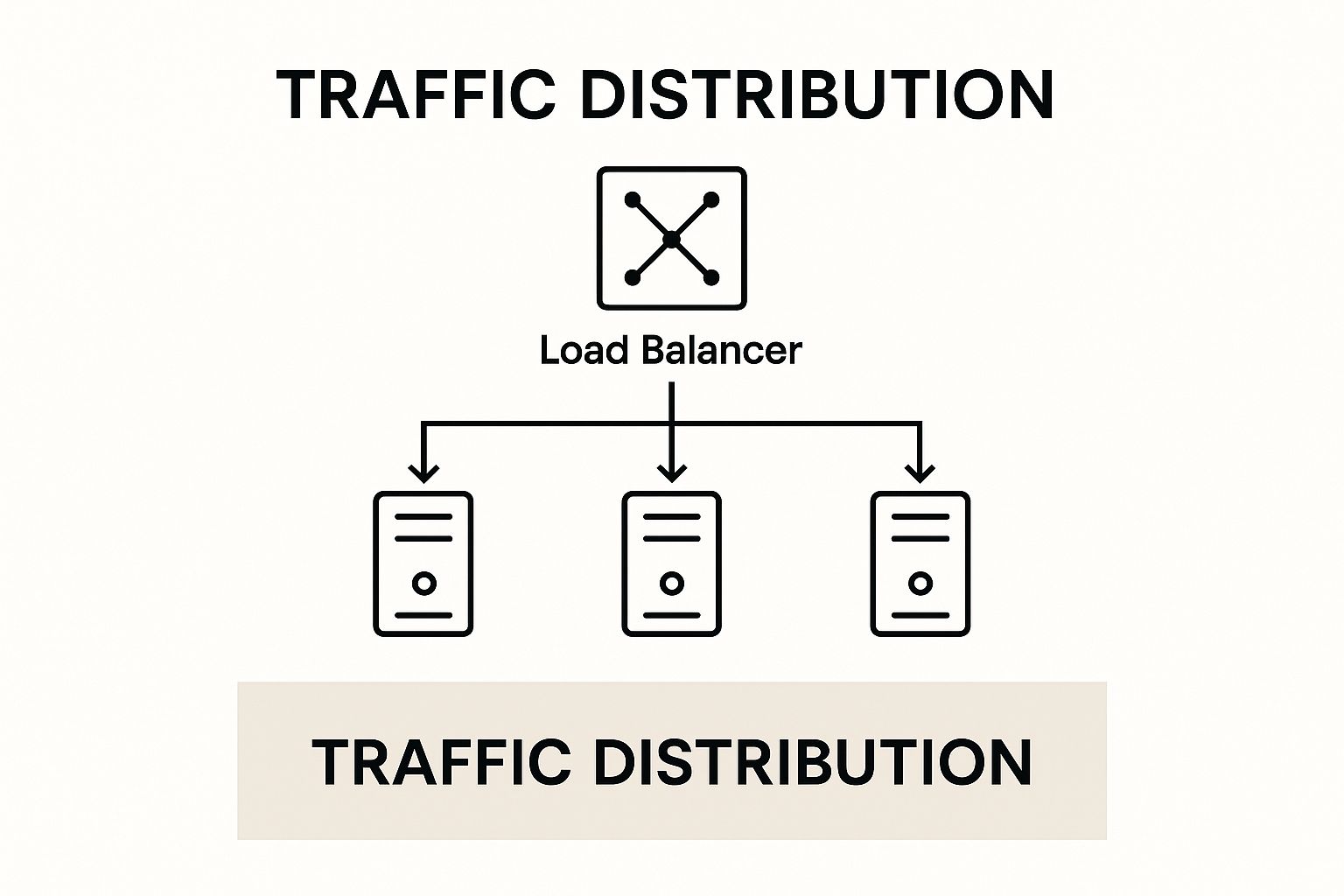
The objective is always to maintain smooth traffic flow and prevent any server from becoming a performance bottleneck.
Round Robin
Round Robin is the most straightforward and widely used algorithm. It distributes requests to servers in a cyclical sequence. The first request goes to Server 1, the second to Server 2, and so on. Upon reaching the end of the server list, it loops back to the beginning.
The primary benefit of Round Robin is its simplicity and predictability. However, its main drawback is that it assumes all backend servers are identical in terms of processing power and capacity. In heterogeneous environments, this can lead to uneven load distribution.
Least Connections
The Least Connections algorithm is a dynamic distribution method that is more intelligent than Round Robin. Before routing a new request, the load balancer checks which server currently has the fewest active connections. The request is then sent to that server.
This method is highly effective in environments where session durations vary significantly, as it naturally prevents one server from becoming overloaded while others are underutilized. It results in a more evenly balanced workload across the server pool.
IP Hash
For applications that require a user to maintain a session with the same server, session persistence (or “stickiness”) is critical. The IP Hash algorithm addresses this need. It computes a hash of the client’s source IP address to deterministically map the client to a specific server.
As long as the server pool remains unchanged, this hash ensures that all requests from a particular client IP are consistently routed to the same server. This is essential for stateful applications, such as e-commerce shopping carts or authenticated banking sessions, where routing to a different server mid-session would result in data loss and a broken user experience.
Comparing Load Balancing Algorithms
This table breaks down popular load balancing algorithms, their distribution methods, and ideal use cases for technical evaluation.
| Algorithm | Distribution Method | Best For |
|---|---|---|
| Round Robin | Cyclical, sequential distribution to each server in order. | Environments where servers have similar capabilities and traffic is consistent. |
| Least Connections | Sends new requests to the server with the fewest active connections. | Situations with varying session durations, preventing server overload. |
| IP Hash | Assigns a client to a specific server based on their IP address. | Applications requiring session persistence, like e-commerce or online banking. |
| Weighted Round Robin | A variation of Round Robin where servers with higher capacity receive more traffic. | Networks with servers of different processing power and memory. |
| Least Response Time | Directs traffic to the server with the fewest active connections and lowest average response time. | Customer-facing applications where speed is the top priority. |
Each algorithm provides a different solution to the challenge of efficient traffic management. The optimal choice is contingent on specific application requirements, whether the priority is raw performance, session integrity, or simple, even distribution.
Strategic Benefits of Load Balancing
Implementing a load balancer is a strategic architectural decision that enhances the reliability, scalability, and security of the entire IT infrastructure.
The most direct benefit is achieving high availability and fault tolerance. By distributing traffic and performing health checks, a load balancer ensures that applications and services remain operational even during a backend server failure. If a server becomes unresponsive or is taken offline for maintenance, traffic is automatically rerouted, making the failover transparent to end-users.
This capability to guarantee uptime has a direct financial impact by preventing costly outages, protecting revenue, and preserving customer trust.
Boosting Scalability and Security
Beyond availability, network load balancing is fundamental to achieving seamless scalability. As application traffic grows, new servers can be added to the resource pool without downtime. This elasticity allows infrastructure to scale horizontally in response to business growth or traffic spikes, ensuring consistent performance.
Modern load balancers also provide significant security benefits. They can act as a frontline defense by performing SSL/TLS offloading, which involves handling the computationally expensive process of encrypting and decrypting traffic. This frees up backend server CPU cycles to focus on their primary task: serving application content.
By distributing requests across multiple servers, a load balancer is also a critical component in a defense-in-depth strategy against Distributed Denial of Service (DDoS) attacks. It can absorb and distribute a flood of malicious traffic, preventing any single server from being overwhelmed and taken offline.
The global load balancer market size reflects its importance. Valued at approximately USD 5.5 billion, it’s projected to reach nearly USD 20 billion by 2034, with a compound annual growth rate (CAGR) of 13.5%. This growth underscores the critical role of expert traffic management in industries where low latency and high reliability are non-negotiable.
Proper implementation of these benefits is a key element of any comprehensive network security audit checklist. The ability to manage traffic, ensure uptime, and bolster security makes a load balancer an indispensable asset. These principles are also foundational to a resilient connectivity strategy, as detailed in our article on why WAN load balancing is a core of corporate WAN strategy.
Practical Use Cases and Applications
Beyond theory, network load balancing is a core component for any business reliant on its online services. Its versatility provides practical solutions to critical infrastructure challenges across diverse technology stacks and business models.
From managing sudden traffic surges to guaranteeing service availability, load balancers are the unsung heroes of backend infrastructure, providing effective solutions to common engineering problems.
Supporting High-Traffic E-commerce
Consider a major e-commerce platform launching a flash sale. Traffic can surge by orders of magnitude—potentially 100x baseline levels—within minutes. Such an influx would immediately overwhelm a single-server architecture. Here, a load balancer proves its value.
It acts as a traffic director, dynamically distributing the flood of customer requests across a fleet of web servers. This maintains site responsiveness, prevents cart abandonment due to timeouts, and averts revenue loss. When the event concludes and traffic normalizes, it continues to manage resources efficiently, demonstrating its value in volatile environments.
The growth of e-commerce is a key driver for the load balancer market, which is projected to grow from USD 6.2 billion to USD 13.82 billion at an 18.4% CAGR. This data, detailed in this research report on the load balancer market, highlights its critical role in enabling digital commerce scalability.
Enabling Modern Application Architectures
The industry-wide shift towards microservices architectures has made load balancing more critical than ever. Instead of a single monolithic application, modern software is typically composed of numerous small, independent services communicating via APIs.
In this distributed model, load balancers function as essential traffic managers for inter-service communication. They route requests between microservices, ensuring that a failure or performance degradation in one service does not trigger a cascading failure that brings down the entire application.
This demonstrates how load balancers provide the resilience and scalability required to support distributed systems. They are a foundational component for ensuring that these complex architectures can operate as a single, cohesive, and fault-tolerant system.
Evolving Load Balancing for WAN Connections
The principles of load balancing, originally applied to server farms, are now being strategically implemented at the network edge. This evolution extends beyond distributing traffic across local servers to balancing traffic across multiple internet connections. This is the domain of modern technologies like SD-WAN and multi-WAN bonding, which apply load balancing concepts to Wide Area Network (WAN) links.
This application is known as WAN load balancing. It involves aggregating multiple, disparate internet circuits into a single, logical, high-bandwidth connection, significantly enhancing network resilience and performance.
Aggregating Multiple Internet Connections
Instead of relying on a single ISP, organizations can now aggregate a diverse mix of transport types to create a more robust and performant network. This often includes bundling circuits such as:
- High-speed fiber optic lines
- Business cable
- Cost-effective DSL
- Wireless 4G/5G for primary or failover connectivity
- Satellite for remote or hard-to-reach locations
An intelligent multi-WAN appliance bonds these disparate circuits into a unified data pipe. The result is a connection that offers greater bandwidth, higher resiliency, and superior performance than any single link could provide on its own.
This strategic shift from server-centric load balancing to multi-link WAN aggregation represents a significant advancement in network architecture. It effectively addresses the “last-mile” connectivity challenge, ensuring that the performance and reliability engineered into the data center are not compromised at the internet gateway.
This technique utilizes intelligent, session-level load balancing for both ingress and egress traffic. For example, if a mission-critical VoIP call on a primary fiber line begins to experience packet loss or jitter (a “brownout”), a multi-WAN system can seamlessly and instantly steer that session to a more stable cable or LTE link without dropping the call. This is often integrated within a broader strategy of virtualizing network functions, a topic detailed in our guide on what Network Function Virtualization (NFV) is.
The ultimate outcome is application continuity. This ensures that critical business tools—video conferences, SaaS platforms, and unified communications—remain operational regardless of individual circuit performance. Even with a full outage of one or more internet links, business operations continue without interruption. The foundational concept of load balancing has been repurposed to provide a new level of uptime for the modern, cloud-dependent enterprise.
Frequently Asked Questions About Load Balancing
Even with a firm grasp of the fundamentals, practical implementation details often raise further questions. Here are answers to common queries from IT professionals working with network load balancing.
What’s the Real Difference Between Layer 4 and Layer 7 Load Balancing?
The distinction lies in which layer of the OSI model the load balancer operates, which dictates the type of data it can use to make routing decisions.
Layer 4 (L4) load balancing operates at the transport layer (TCP/UDP). It makes routing decisions based on information in the network and transport layer headers, primarily source/destination IP addresses and ports. Because it does not inspect the packet’s payload, it is extremely fast and requires minimal processing overhead. It routes traffic based on network-level information.
Layer 7 (L7) load balancing operates at the application layer. This allows it to inspect the content of the data packets, such as HTTP headers, cookies, and SSL session IDs. This enables more intelligent, content-aware routing decisions. For example, an L7 load balancer can route requests to different backend pools based on the URL path (e.g., /images vs. /api), ensuring requests are handled by the most appropriate specialized servers.
How Does a Load Balancer React When a Server Goes Down?
A core function of a load balancer is to monitor the health of all servers in its resource pool. It performs periodic health checks to verify that each server is not only reachable but also capable of serving requests correctly.
Health checks can range from a simple ICMP echo request (ping) to a more sophisticated check that simulates a user transaction, such as an HTTP GET request to a specific endpoint that queries a database. If a server fails a health check, the load balancer immediately marks it as “down” and removes it from the pool of active servers. All new traffic is instantly redirected to the remaining healthy servers, making the failover process transparent to users and preventing downtime.
Does Network Load Balancing Actually Make My Network More Secure?
Yes, it contributes significantly to a layered security posture. A load balancer acts as a reverse proxy, creating a protective abstraction layer between the public internet and backend servers.
First, it can perform SSL/TLS termination, offloading the CPU-intensive task of encrypting and decrypting traffic from the web servers. This also centralizes TLS certificate management, simplifying administration and reducing the attack surface.
More critically, a load balancer is a key defense against Distributed Denial of Service (DDoS) attacks. By distributing the attack traffic across the entire server pool, it can absorb volumetric attacks that would otherwise overwhelm a single server. Many modern load balancers also integrate a Web Application Firewall (WAF), which inspects L7 traffic to detect and block application-level threats like SQL injection and cross-site scripting (XSS), adding another crucial layer of security.
At Mushroom Networks, we take these principles and apply them to your entire internet connection. Our multi-WAN bonding devices use this same intelligent load balancing logic, but for your internet circuits—not just your servers. This ensures your business and its critical applications stay online, no matter what happens to one of your connections.
You can learn more about how our SD-WAN solutions deliver unmatched application reliability.