
Antennas
For devices that use embedded cellular modems, we provide antennas that support 4G/5G bands for indoor use. For outdoor use, we recommend consulting an antenna provider for the best solution. We buy our indoor antennas from a provider who also offers advanced external/automotive antennas.
If you plan to use an external splitter for the antennas, make sure it supports 4G/5G bands, and the cable impedance matching should be 50 ohms. We recommend using RG58C/U cable.
The antennas should support MIMO technology with dual connection (Main + Diversity) for each 4G modem or quadruple connection (M1, D1, D2, D3) for each 5G modem. The diversity antenna serves as a second receive-only antenna port, improving the receive signal quality by up to 3dB. This significantly improves the connection quality and reliability, especially in urban areas where multiple antennas may experience different interference effects.
4G/5G networks require more than one antenna for proper operation, so customers should not deploy their systems with diversity antennas disconnected.
Cable types
The following table describes common cable types, their main parameters, and the recommended maximum length.
Antenna cable impedance must be 50 ohms. If there is an impedance mismatch, it can impact RF performance. Consult with the cable vendor as needed.
| Cable type | Cable diameter (mm) | Signal loss (db) @800MHz 3m (10′) |
Signal loss (db) @1900MHz 3m (10′) |
Maximal cable recommended length (m) |
| RG174U | 2.5 | 3.58 | 6.66 | 3 |
| RG58U | 5.0 | 1.00 | 2.66 | 10 |
| LMR195 | 5.0 | 1.12 | 2.54 | 16 |
| LMR200 | 5.0 | 0.99 | 2.30 | 18 |
| LMR400 | 10.0 | 0.40 | 1.07 | 100 |
| 1250 | 12.5 | 0.18 | 0.48 | 200 |
Here are a few examples of the recommended outdoor antennas:
Permanent mount MIMO 4G selection:
Adhesive mount MIMO 4G selection:
Magnetic mount MIMO 4G selection:
Permanent mount MIMO 4G/5G selection:
Boosters:
Since the gain of broadband boosters is limited by the FCC, we recommend using a carrier-specific booster where possible, especially if you have a weak signal at the outdoor donor antenna location. Currently, the only carrier-specific boosters available are made by Cel-Fi. You may need to consult with Cel-Fi to find the best solution for your specific use-case.
Note: Verizon Wireless, AT&T, Sprint, and T–Mobile have approved all boosters that contain the label, so you do not need to get approval again.
If the booster does not have this label
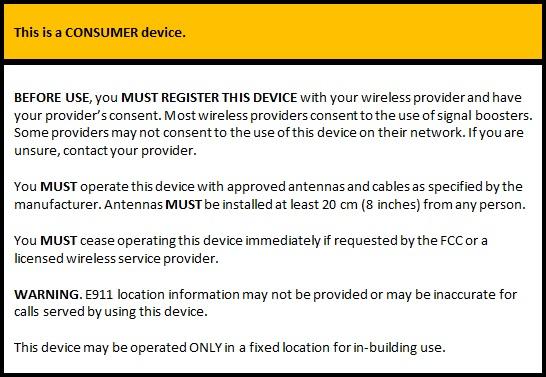
- Get permission from you wireless provider to use it.
- Register your booster with your wireless provider before turning it on. Each wireless provider that gives permission for boosters to be used must provide a free registration system.